 |
| First American edition published by Pantheon in 1966 |
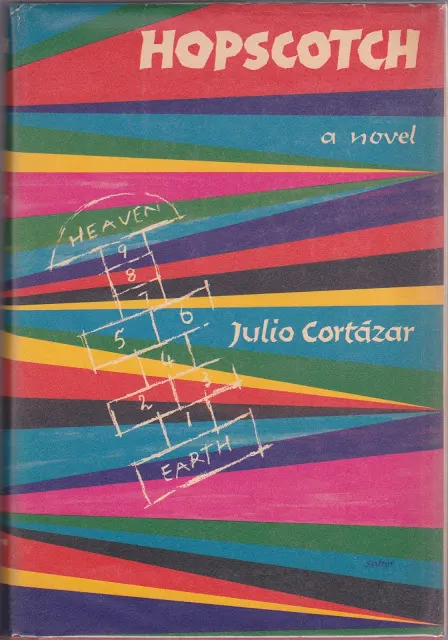
Let me begin by saying that this is my favorite book cover, ever. I think it's pretty easy to see why this jacket designed by acclaimed designer George Salter is so amazing, and why in a lot of ways more important to me than the contents of the book itself. If you've read
Hopscotch by Julio Cortazar, the cover illustrates and condenses the feel of the book's contents incredibly well, which is something Salter was considered revolutionary for being able to do. Without question one of the world's most important book designers who did covers for every major 20th century author, Salter designed this beautiful cover of
Hopscotch the year before he died at the end of his career of many decades. Between the covers Cortazar's novel is an interesting one, and there was definitely nothing like it before its publication—it is, however, not an easy book to read for a lot of reasons. It is very long and can often be tedious, but it is also absurd, witty, inventive, and sad. What makes
Hopscotch so interesting is that Cortazar devised the book to be read either in a linear fashion, from chapters 1 through 56, or by playing "hopscotch" so to speak, and jumping to the chapter Cortazar tells you to at the end of the one you're reading. By reading it using the "hopscotch" method you end up reading all six hundred pages or so. Although very daunting, I think it's more fun to read it that way.
 |
| Back cover author photo of Cortazar sporting a nice unibrow |