Showing posts with label Paperback. Show all posts

Tuesday, February 5, 2013

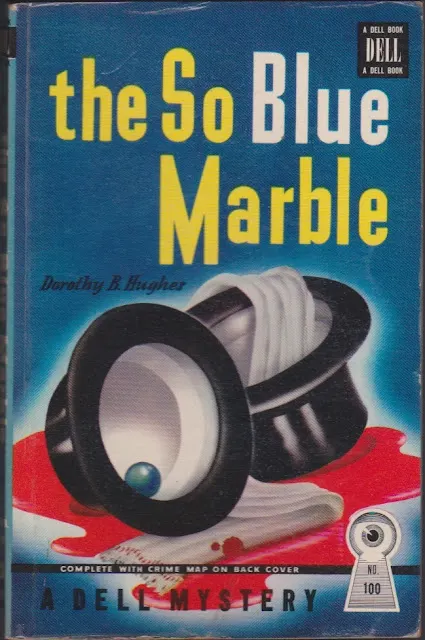
The So Blue Marble by Dorothy B. Hughes

Dell Mystery edition of The So Blue Marble from 1946
The So Blue Marble is Dorothy B. Hughes' first novel and foray into mysteries, a genre to which she would go on to dedicate the majority of her career. Hughes was one of the more talented and recognized female mystery writers of the 20th century, and The So Blue Marble marks the beginning of her fun-to-read stories of suspense from 1940. This Inspector Tobin mystery follows former movie star Griselda Satterlee as she comes to glittery, mid-century New York City to relax and stay in her ex-husband's apartment while he's away. Griselda quickly finds herself in the center of a plot to regain an ancient blue marble, which feature the identical, sinister Montefierrow twins, who are convinced that Griselda has the eponymous marble. The reader learns that the marble apparently holds a secret, ancient formula which can be used to master gravity. As bodies pile up around the city, Griselda must work with Inspector Tobin to get the twins off her back and end the string of murders. While the driving force of the plot is a little farfetched, Hughes' book is incredibly engaging to read and one will quickly overlook how fantastical it is. Featuring great cover art of the twins' matching top hats in a pool of blood (by an unknown illustrator), this Dell Mystery edition is a wonderful artifact of the genre.

Back cover featuring the convenient Crime Map, which depicts the relevant areas where a murder took place

Wednesday, January 2, 2013

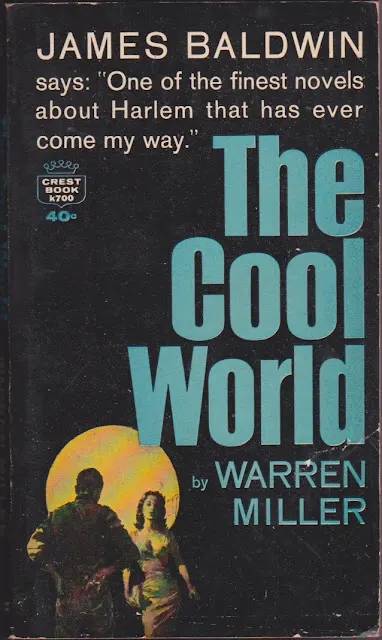
The Cool World by Warren Miller

Second edition paperback copy of The Cool World from 1964 
First published in 1959, The Cool World is the most famous of Warren Miller's work (all of which is relatively unknown) about a youth gang called the "Crocadiles" in 1950's Harlem, New York City. Narrated in the first person by the protagonist and Crocadile member Duke, The Cool World recounts the story of Duke and his gang's adventures and travails as they deal with street life in the ghetto and a rival gang called the Wolves. Drug dealing, fights, prostitution, guns, and gambling are rampant throughout this engaging, slim novel that rarely has a dull moment. Written entirely in African-American street vernacular of the time, Miller—a caucasian academic—accomplished a great, and mostly unnoticed, linguistic and narrative feat with this novel. The Cool World has been out of print since the late 1960's, but paperback copies aren't too difficult to come by—the featured copy above was published by Crest Books, a subsidiary of Little, Brown. Slightly better known than Miller's novel is a film adaptation by Shirley Clarke of the same name, also from 1964, which happens to be playing at Film Forum in New York on January 13th and 14th. I strongly suggest seeing it if you live in the five boroughs, as well as locating a copy of this forgotten novel.

Friday, September 21, 2012

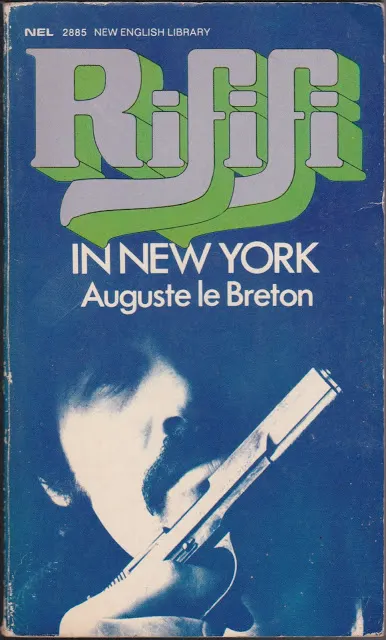
Rififi in New York by Auguste le Breton

Paperback edition from 1970 published by the New English Library
First published in France in 1967, Rififi in New York is part of Auguste le Breton's series of Rififi crime novels featuring an assortment of criminals and cops that take place in various cities around the globe. Le Breton himself began his career as a small-time crook, calling himself "a man of the underworld," and later became a hero in the Resistance during the Nazi occupation of France. After the war le Breton turned his focus to writing, and became a prolific writer of novels that typically revolve around criminals and their schemes or heists. Le Breton was a big proponent of slang in his novels, and coined the word "Rififi," which he legally owned, and is slang for a sort of conflict or melee. Rififi in New York is one of the better Rififi novels (next to the original Rififi) and features a crew of independent gangsters as they try and steal $20 million in jewels from the Diamond Exchange, all the while trying to stave off the mafia and the police. Le Breton came to New York to write this novel, and it features a greatly detailed landscape of 1960's New York City. With great cover art and typography by an unknown designer, as well as an odd Charles Bronson look-alike, le Breton's novels and Rififi in New York definitely deserve checking out.

Sunday, September 9, 2012

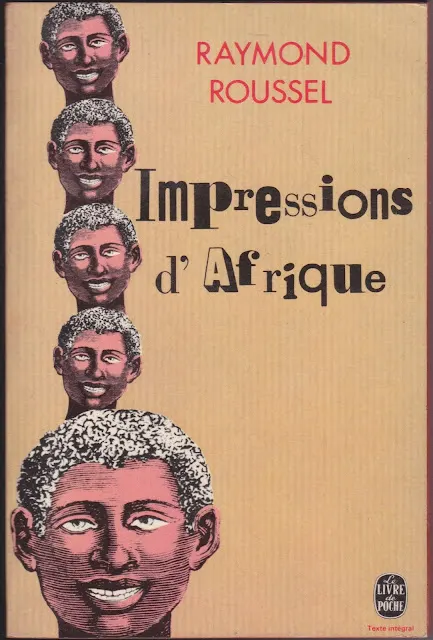
Impressions of Africa by Raymond Roussel

Early French paperback printing of Impressions of Africa
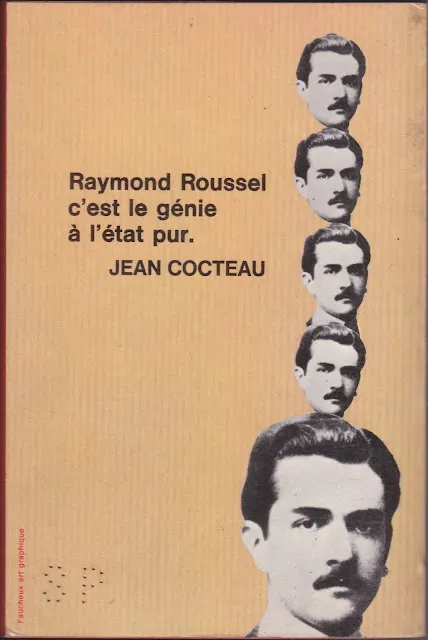
This French novel by Raymond Roussel was an inadvertent forefather to the surrealist movement; Impressions of Africa recounts the fantastical tale of shipwreck survivors to a fictitious land in Africa. Together, each distinct member must perform their unique, ridiculous talent before Emperor Talou, and great absurdities ensue. First published in 1910, Roussel's novel was also unique for its unusual narrative and sentence structure, which relies heavily on puns and other wordplay. Aside from being a little on the nonsensical side and somewhat dated, Impressions of Africa is not difficult to read and is definitely worth giving a shot. This French edition by Livre de Poche from 1963 is particularly notable for it's amazing covers done by renowned designer and illustrator Pierre Faucheux, who revolutionized book covers in France from the 1950's and 1960's on, treating them as works of art. These surrealist collages that don the front and back of this edition are perfect examples of his work. 

Back cover with Roussel's photo, note the Faucheux credit in the bottom left corner

Wednesday, September 5, 2012

Solaris by Stanislaw Lem

A later printing of Solaris from Berkeley Science Fiction in 1980
As it says on the cover, Solaris is probably Stanislaw Lem's greatest and definitely his most well known work. First published in English in 1970, Polish science fiction writer Lem's novel recounts Dr. Kris Kelvin's travels to the eponymous planet along with his research team to gather data. Solaris is mostly compromised of a strange ocean that the scientists are there to study and communicate with, but what they soon discover is that the highly-sentient planet is actually studying them. Facing each of the scientists with reconstructed people and problems from their past, Solaris is observing the frailty and ultimate inadequacy of human life as they each break down. While Lem's novel has been adapted into several film versions, none of them focuses so much on the extraordinariness of Solaris and its ocean, which Lem believed likely to actually exist, and only showed more of the human weakness instead. This edition features great traditional sci-fi paperback artwork by an unknown cover artist.

Wednesday, August 8, 2012

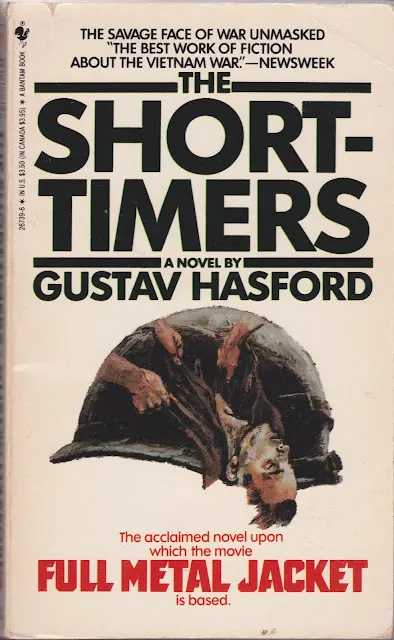
The Short-Timers by Gustav Hasford

Fourth Bantam paperback printing of The Short-Timers from 1988
The Short-Timers was Vietnam veteran Gustav Hasford's first novel based largely on his experiences as a combat correspondent during the war. First published in 1979 to the bestseller list and currently out of print, The Short-Timers was adapted into the Stanley Kubrick film Full Metal Jacket in 1987 to great acclaim. Kubrick's film largely remains true to the novel with minor differences, and Hasford himself helped pen the screenplay; following an Oscar nomination, however, the amount of Hasford's actual work came under scrutiny by co-writers Kubrick and fellow veteran Michael Herr. At the same time, it was discovered that Hasford had been checking out and never returning books from various university libraries around the country under a phony social security number. Nearly ten thousand stolen books were discovered in his storage locker in California, for which he ultimately paid restitution and served three months in jail. The Short-Timers is a great piece of fiction by itself, and without it Full Metal Jacket couldn't have existed; that said, Hasford's literary career was a short, staggering one that only saw the publication of a sequel to this novel 12 years later (probably written for the money) and a flimsy, unnoticed detective novel published a year before his death. The Short-Timers is without a doubt Hasford's slim masterpiece, and supports believers of the notion that some writers only have one good book in them.

Tuesday, July 31, 2012

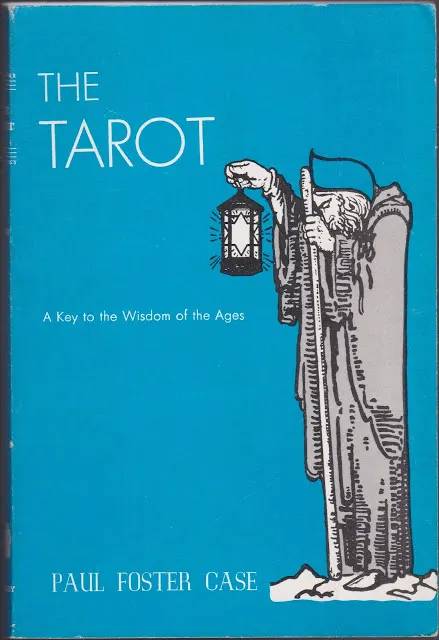
The Tarot by Paul Foster Case

Paperback reprint of The Tarot from 1975
Originally published in 1947 a few years before his death, The Tarot by Paul Foster Case is largely regarded as one of the seminal texts on discerning the Tarot. Born in 1884, Case became an occultist in his teens and developed his lifelong passion for the Tarot in 1901, 46 years before the publication of this book. Case was at times a Freemason, a member of the order of the Golden Dawn, and later founded his own Mystery School called The Ageless Wisdom which is still in existence. Case's text, published and reprinted by the Macoy Publishing Company, discusses and explains in depth the 22 major arcana from the Tarot deck for divination, and is to be used in conjunction with Case's own deck that he developed called the B.O.T.A. deck (for Builders of the Adytum). Case's book was revolutionary for relating each of the keys of the major arcana to their Hebrew letter counterpart from the Qabalah and the Cube of Space/Tree of Life, and especially in a time when few people studied such things. Despite any belief or practice of the Tarot, Case's book is interesting nonetheless and explains to a degree the origins of playing cards. Pictured on the cover is an illustration of The Hermit, which is key number 9 of the major arcana, and is one of many beautiful wood-cut illustrations by an unknown artist that fill Case's book.

Saturday, July 21, 2012

The Bodysurfers by Robert Drewe

Reprinting of The Bodysurfers from 2009 Penguin Australia
First published in 1983, Robert Drewe's The Bodysurfers is a classic of Australian literature. Hailed as a sort of J.D. Salinger from Australia, this short-story collection recounts the ups and downs of the Lang family over multiple decades. The settings for most of the book are the many Australian beaches that members of the Lang family frequent, which Drewe himself grew up going to and clearly loves. For some reason Drewe doesn't have the biggest audience in the U.S., although a lot of his books have been printed here. I've only read The Bodysurfers, which I thoroughly enjoyed, but from what I understand his other books are just as good. This Popular Penguins paperback is an Australian edition with the awesome stock cover used for all overseas paperback editions. It should also be self-evident that this book makes for great summer beach reading.

Tuesday, July 17, 2012

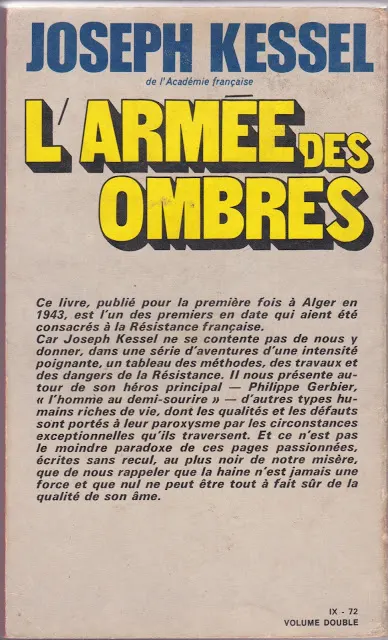
Army of Shadows by Joseph Kessel

Pocket Francais paperback edition printed in 2007
Known in English as Army of Shadows, the official title of Joseph Kessel's 1943 novel in French is L'armee des ombres. I have read other books by Joseph Kessel (Belle de Jour, The Lion, etc.), which have translated copies currently in print, but I have a feeling that they pale in comparison to Army of Shadows—unfortunately, I've been unable to track down a readable copy of the only English translation printed in 1944 by Cresset Press. The main reason why I'm even aware of this book, along with most other English speakers, is because of Jean-Pierre Melville's film adaptation of the same name from 1969. The movie is a pleasantly sprawling tale of the French Resistance and its members as they try to combat oppressive Nazi forces in their homeland. Told on the bleaker side and shot in beautiful blue and gray hues of color, Melville's film adaptation is by far one of his best movies and my favorite. All of these things lead me to believe that Kessel's novel must be equally as amazing, if not more so. Based largely on Kessel's own war-time resistance experiences, as far as I understand it, the movie remains pretty faithful to the text. A year ago I sent an inquiry to NYRB about printing a new English translation but no one ever got back to me. Maybe there are rights issues or other things connected with Kessel's estate that I'm unaware of, but I hope that someday someone releases another English edition of this book so I can finally read it.

Back cover of an older Pocket Francais paperback from 1972 

Sunday, July 8, 2012

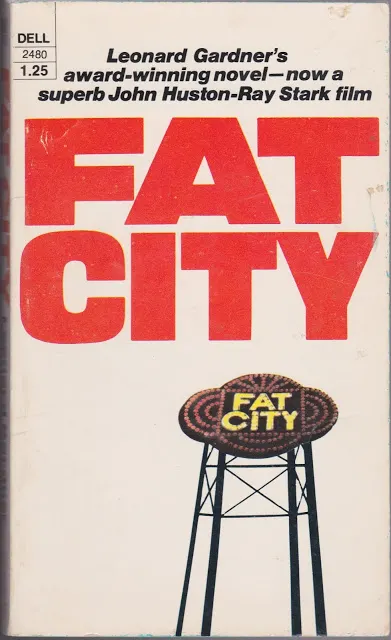
Fat City by Leonard Gardner

Movie tie-in paperback edition of Fat City from 1972
Leonard Gardner's first and only novel remains a relatively obscure classic of boxing fiction. Set in the small town of Stockton, California where Gardner grew up, it follows the emerging career of Ernie Munger and the washed-up career of Billy Tully, two semi-professional lower-class boxers. Originally published by Farrar, Straus, and Giroux in 1969, this paperback edition was published by Dell in conjunction with John Huston's film adaptation written by Gardner himself. Fat City is a fairly bleak book but an incredibly gripping one to read, and highlights a particular time and sub-genre of people in rural California as they try to make it to the big time, or "fat city" as it were.

Friday, June 8, 2012

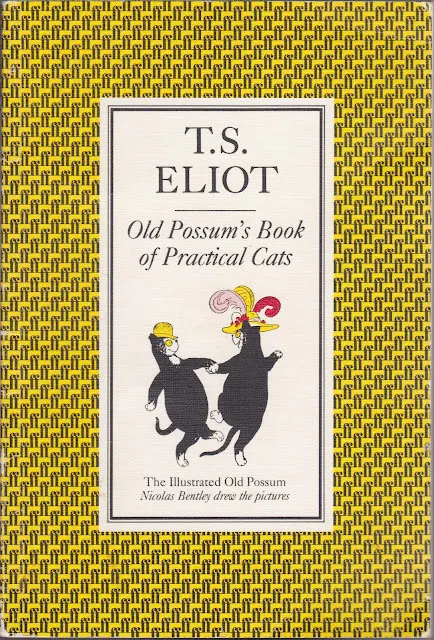
Old Possum's Book of Practical Cats by T.S. Eliot

Softcover British edition published by Faber and Faber from 1989
This British edition of Old Possum's Book of Practical Cats by T.S. Eliot differs largely from most popular American versions because Edward Gorey didn't do the illustrations; instead, "Nicolas Bentley drew the pictures," according to the front cover. First published in 1939 with Bentley's illustrations, this book of whimsical cat poems is a lot lighter than most of T.S. Eliot's other work as it was written mostly for his godchildren. It also served as the basis for the musical Cats, although whoever adapted it definitely took a lot of creative liberties. This slim volume is entertaining for adults and children alike, and features a nice monogrammatic Faber cover with one of Bentley's illustrations.

Sunday, June 3, 2012

The Devil's Home On Leave by Derek Raymond

First British paperback edition from 1985 published by Abacus
This is the second book by Derek Raymond, the pen-name of English author Robert Cook, in his Factory Series about an unnamed Detective Sergeant working in the Unexplained Deaths department. The Devil's Home On Leave follows the Detective trying to solve the murder of a body chopped up, boiled, and casually dispersed on the street amongst five plastic shopping bags. Featuring a gritty cast of London underworld characters, known as "Villains," and the Detectives who pursue them, Raymond's novel is filled with intrigue and written mostly using amazingly authentic British slang. Raymond himself was a British gangster at one point, among many other things in his lifetime, before later becoming a novelist, and is considered to be the founder of British Noir with this series. Although this is the second book of five in the Factory Series, The Devil's Home On Leave is the best one in my opinion.

Friday, June 1, 2012

Berlin Alexanderplatz by Alfred Döblin

Movie tie-in edition published by Frederick Ungar Publishing Co.
This edition of Berlin Alexanderplatz by Alfred Döblin was released sometime after Rainer Werner Fassbinder's adaptation aired in 1980, although the exact year is unspecified. Döblin's novel was originally published in German in 1929 with cover art by George Salter early on in his career. Lauded as a masterpiece of European literature, Berlin Alexanderplatz is the story of criminal Franz Biberkopf upon his release from prison and follows his attempt to lead a crime-free existence—trouble and crime obviously ensue. I read somewhere that Döblin finished his first draft of Berlin Alexanderplatz and then read Ulysses by James Joyce and completely rewrote the entire book, which was subsequently published. The stylistic parallels between the two are thinly-veiled at best. That said, it also isn't an easy book to read, nor is it easy watching Fassbinder's fifteen-plus hour film version, but they both have a fair amount of merit and a solid story. The cover features a still from Fassbinder's film designed by Ted Bernstein.

Wednesday, May 30, 2012

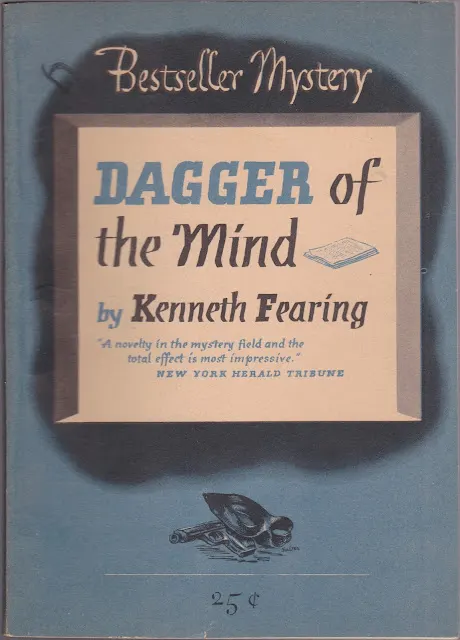
Dagger of the Mind by Kenneth Fearing

Bestseller Mystery edition from 1941 
Originally published by Random House in 1941, Kenneth Fearing's Dagger of the Mind was reprinted in this digest-sized Bestseller Mystery (published by Lawrence Spivak) softcover later the same year. According to the title page, "Titles for the Bestseller Mystery are chosen from those mysteries which have had a large and continuing sale. Sometimes they are reprinted in full, but more often they are cut to speed up the story—always, of course, with the permission of the author or his publisher. This book has not been cut." Publishing has come a long way since 1941 and, thankfully, Fearing's second novel was spared from being ellipsed in any way. Fearing was a progressive mystery writer who began as a poet and brought new stylistic twists to a genre that was usually pretty formulaic. This book, although out of print since the 1960's, along with Fearing's other novels (a couple are currently in print on NYRB) definitely deserve reading.

Close-up of the Bestseller Mystery logo on the back cover

Monday, May 28, 2012

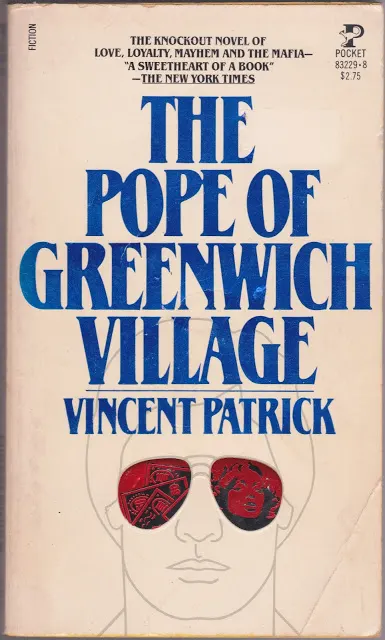
The Pope of Greenwich Village by Vincent Patrick

Paperback edition published by Pocket Books in 1980
Vincent Patrick's first novel, originally published in 1979, chronicles the lives of some New York low-lives and the mob at the end of the 1970's. Focused largely in downtown Manhattan, Patrick's novel was the inspiration for the film starring Mickey Rourke and Eric Roberts, which Patrick helped write. While many more people are aware of the film version, in my opinion the book is much better and slightly different—a main change being that Barney, the safecracker, has a retarded son who was left out of the movie. The language and dialogue Patrick uses are excellent and authentic; the first of his three books definitely deserves reading, whether you've seen the movie or not.

Friday, May 25, 2012

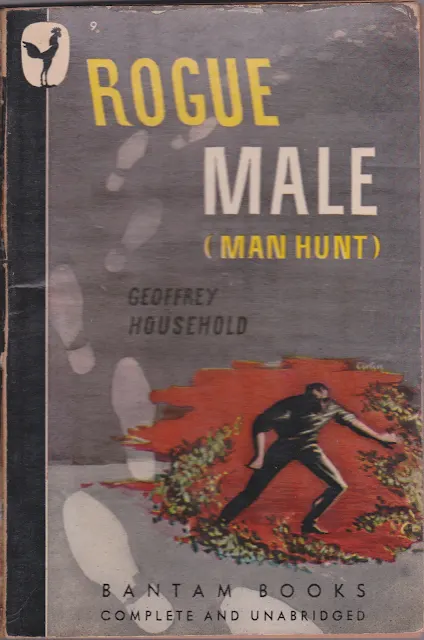
Rogue Male by Geoffrey Household

First edition, second printing published by Bantam in 1946
Originally published in 1939 on the brink of World War II, Geoffrey Household's thriller/adventure novel tells the story of a hunter's attempt to assassinate an unsaid European dictator. The protagonist, who has no name, goes on this mission for "sport," but it obviously turns into much more and adventures ensue. A later Penguin paperback (that I unfortunately don't own) features a man bearing an uncanny resemblance to Hitler on the cover, further insinuating the dictator's identity. Featuring nice 1940's cover art by an unattributed artist, this book is a great read and I strongly encourage picking up the NYRB reissue from a few years ago, currently in print.

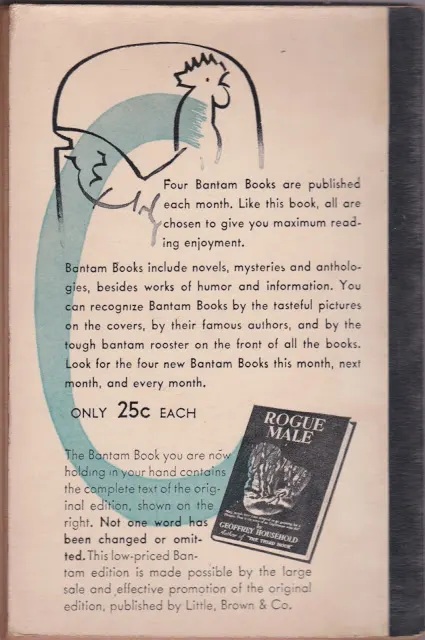
Back cover featuring a picture of the original first edition 

Monday, May 21, 2012

This Planet Is Doomed by Sun Ra

First paperback edition of This Planet Is Doomed by Sun Ra
From the back cover by Bhob Stewart: "Beyond the interplanetary theatricality, catchphrases, non sequiturs, science-fictional costumes and kozmic chaos, Sun Ra (1914-1993) was an innovative bandleader, a potent pianist, an electronic keyboard pioneer, a visionary Afrofuturist poet-philosopher, an inventive composer and a prolific recording artist, releasing more than 100 albums totaling over 1000 tunes. Downbeat called him 'the prophet of modern jazz.' When the avant-garde arrived, they found that Sun Ra had already been there. 'I'm a troubleshooter for the cosmos,' said Sun Ra, 'sent here by the outer space beings from my home planet, Saturn.'" Sun Ra was, without question, a weird guy. Collected in this book for the first time by Kicks Books in 2011 are all of Sun Ra's celestial, be-bop musings and stories from space in the form of mostly free-verse poetry. This book is more fascinating than it is good, especially if you're in to Sun Ra at all—it also pioneered a "unique" genre of poetry. The cover design by Patrick Broderick is amazing, especially for something not more than a year or two old.

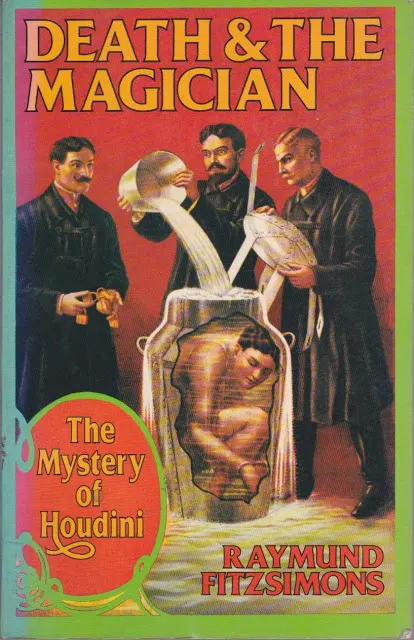
Death & The Magician by Raymund Fitzsimons

Paperback edition from 1985 of Death & The Magician 
First published by Antheneum in 1980, this Harry Houdini biography by Raymund Fitzsimons encapsulates the magician's life from birth to unfortunate death. One of the greatest performers and magicians of the 20th century, this book particularly goes into great detail codifying and explaining all of his famous tricks. Almost as good as this later biography itself is the bibliography at the end of it, with a list of nearly every important piece of literature on Houdini and magic. Featuring great cover design by Craig Dodd based on an original Houdini performance poster, this book at least deserves being flipped through.

Friday, May 18, 2012

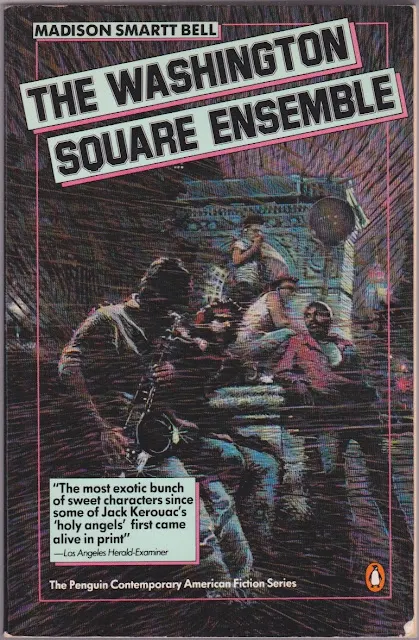
Washington Square Ensemble by Madison Smartt Bell

Penguin paperback copy of Washington Square Ensemble from 1984
Washington Square Ensemble is Madison Smartt Bell's first novel and my favorite. He's more famous for his later works but I like this book best—it chronicles the streets of 1980's downtown New York City, especially the eponymous park, and centers around the struggles of five Washington Square regulars. With characters named Johnny B. Goode, Yusuf Ali, Holy Mother, Santa Barbara, and Porco Miserio, this book is nothing short of interesting. Largely centered around the using and selling of drugs at the height of crime-addled New York, Bell's novel is now an engaging time capsule from a bygone era. The cover features a nice 1980's illustration by David Berkner.

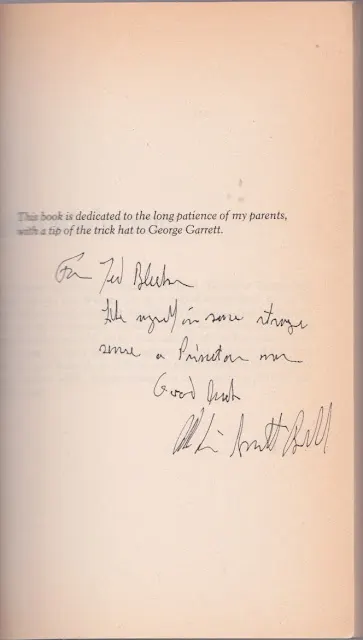
A practically illegible inscription by Madison Smartt Bell

Tuesday, May 15, 2012

The Dead All Have The Same Skin by Boris Vian

Reprinted copy of The Dead All Have The Same Skin by Boris Vian
Boris Vian was a really odd guy in that a lot of his books were about part-black people and Americans, yet he was from Paris and never visited America. He was also completely white. They all take place in cities he never visited, and were about things he had never really experienced; but for this reason, his books are that much more interesting to read. Originally published in France in 1947, Vian claimed to have translated this book and several others from an American author called Vernon Sullivan—more than likely to distance himself from the lewdness, extreme sexuality, and racism that star in this book and most of his others. It soon came out that Vian himself had actually written them, both to popular acclaim and horror. They were successful in France and in the US for their bluntness, "forward-thinking," and ingenuity. The Dead All Have The Same Skin is about a quarter-black man who outwardly appears fully white to his family and co-workers, but whose world is overturned when his fully-black brother appears to extort him. Part noir and racial commentary, the story takes place in an awesomely imagined New York and Brooklyn in the late 1940's, features murder, fighting, drinking, police chases, profanity, and no fewer than 20 sexual exchanges in a novel that's just barely a hundred pages. This book—if you can believe it—is the most straightforward and least ridiculous of Vian's controversial work, although I highly recommend all of it. TamTam books reprinted this novel in 2007 and have since republished most of Vian's works.