Showing posts with label Hardcover. Show all posts

Monday, March 11, 2013

The Wanderers by Richard Price

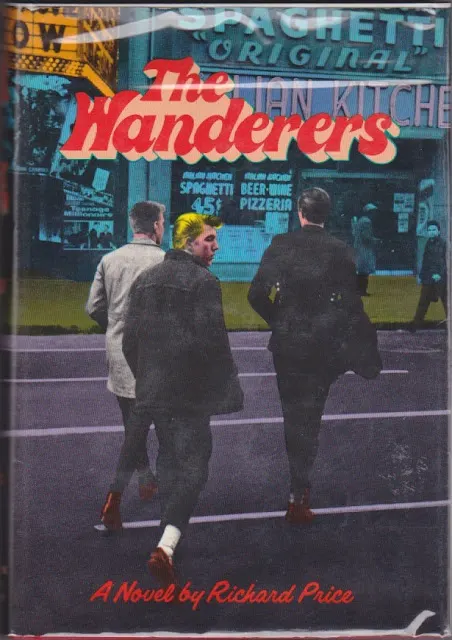
First edition of The Wanderers published by Houghton Mifflin in 1974
The Wanderers is Richard Price's first novel and one of his best; praised by everyone from William S. Burroughs to John Fowles particularly for it's realistic dialogue and accurate street vernacular, the story revolves around a group of teen gangs in the 1960's Bronx, New York City. One of the central characters is Richie Gennaro, leader of the Wanderers gang, and the story mainly follows his development, among other gang members, as he is forced to grow up and confront the real world in various ways. The Wanderers features an incredibly colorful cast of characters from around their neighborhood and rival gangs they must deal with like the Pips and the Baldies. This first edition has amazing cover art done by veteran jacket artists Batten & Kreloff, but The Wanderers is well worth the read no matter what edition you come across.

Monday, February 18, 2013

V. by Thomas Pynchon
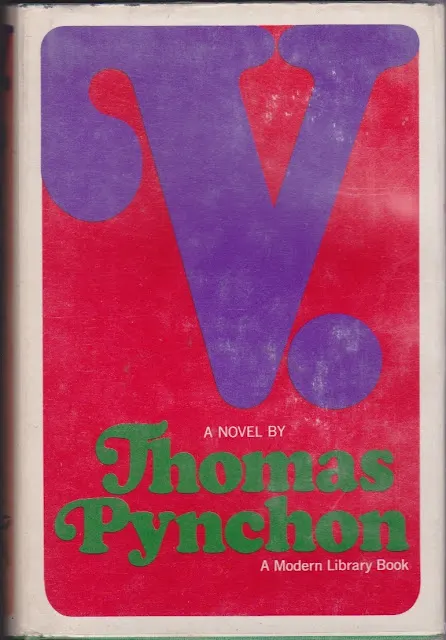
First Modern Library edition of V. by Thomas Pynchon from 1966
Thomas Pynchon's first novel, originally published in 1963, is a book that needs little introduction. Pynchon and his work, although widely known, all fall under the categories of cool, weird, and rare, and this Modern Library edition of his first novel is particularly scarce. V. is probably the most concentrated embodiment of what would later be known as Pynchon's hallmark weird, and technically daring style. It is less complex than Gravity's Rainbow, not to mention shorter, but in my view V. is just as good and definitely easier to get through. One plot line follows sailor Benny Profane and hangers-on from the Whole Sick Crew, and the other follows Herb Stencil and his family's history with a mysterious woman known as "V." The intricately laid plots eventually converge on each other as the novel progresses, forming a V-shape itself as Profane and Stencil cross paths and band together at the end to find V. Pynchon's first novel also features an amazingly diverse cast of characters, many of whom appear more prominently in later works like Pig Bodine and Kurt Mondaugen, and different segments set in various parts of history from all around the world. V. marked the beginning of a new kind of voice and style of writing that had never existed before, and is incredibly important for that reason alone, not to mention being the front bookend of Pynchon's oeuvre. This first Modern Library edition features great, simplistic 1960's cover art by S. Neil Fujita.

Friday, January 25, 2013

All About H. Hatterr by G.V. Desani
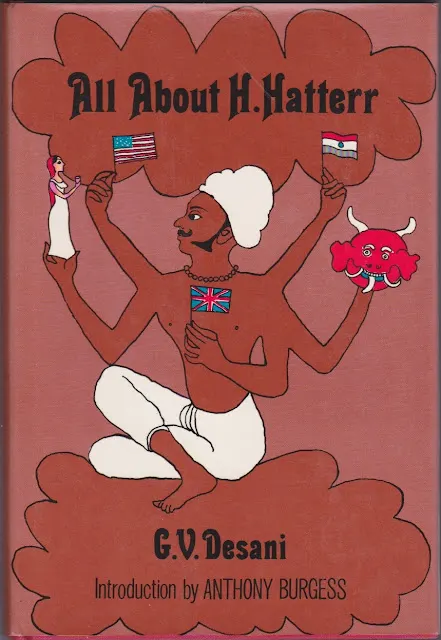
First further revised printing of All About H. Hatterr from 1970
First published in England in 1948, Pakistani author G.V. Desani's only novel remains a strange, whimsical masterpiece following the title character's journey toward spiritual mastery and enlightenment. Hatterr, an Anglo-Malay living in Calcutta, seeks out seven different Sages in seven cities of the Far East to obtain their wisdom in various areas of living. Each section begins with Hatterr recounting the Sage's "instruction," then the "presumption" about the instruction, and concludes with Hatterr's "life-encounter" about the lesson wherein some hilarity and absurdities ensue. All About H. Hatterr has been praised by literary luminaries like Anthony Burgess (who wrote the introduction for this edition), Saul Bellow, and T.S. Eliot, all of whom regard Desani's only novel as an amazing comic and linguistic feat—which it definitely is. Desani's novel is filled with bizarre and unique slang, hilarious dialogue, and excellent wordplay that makes fun of anything close to a spiritual quest. The Sages, various tricksters, and other travelers Hatterr encounters are particularly ridiculous, and are some of the book's funniest moments. With excellent jacket design by Catherine Smolich for this edition published by FSG, All About H. Hatterr is a great, entertaining book that has somehow fallen through a lot of cracks, but definitely deserves to be read.
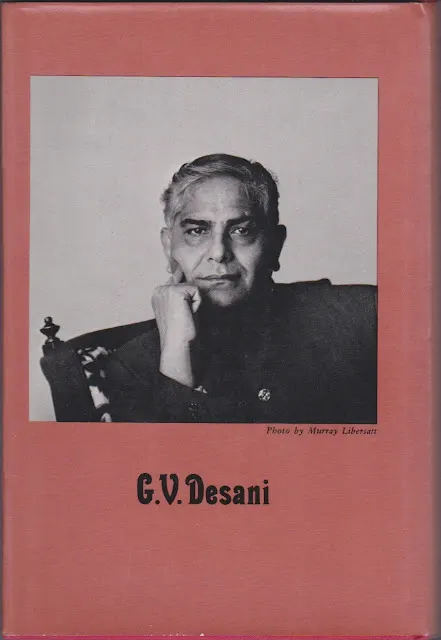
Rear cover with photograph of author G.V. Desani

Friday, December 14, 2012

Maigret in Vichy by Simenon
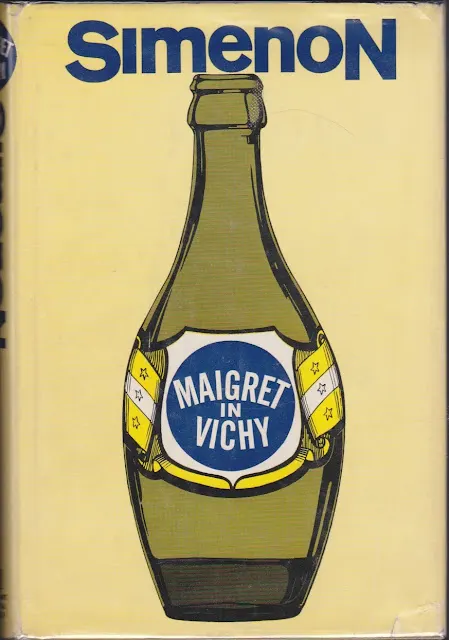
First US edition of Maigret in Vichy published by Harcourt Brace in 1969
One of Simenon's later works featuring the renowned Inspector Maigret, Maigret in Vichy is a slightly different Maigret tale in that it doesn't take place in Paris and Maigret is not in the driver's seat for this mystery. While relaxing on vacation with his famously passive wife in the town of Vichy, Maigret can't help but let his detective mind get to work analyzing the town's inhabitants and others on vacation. He is quickly drawn to a lone woman he keeps seeing, and when murder invariably ensues the local police look to Maigret for his expertise, once again putting his poor wife on hold. Maigret in Vichy is a quick engaging thriller like nearly all of the Inspector Maigret novels, but with a pleasant twist and change of scenery. This first American edition also has one of my favorite covers ever, featuring stellar, simplistic jacket design by Ken Braren.

Friday, November 23, 2012

Subway Lives by Jim Dwyer
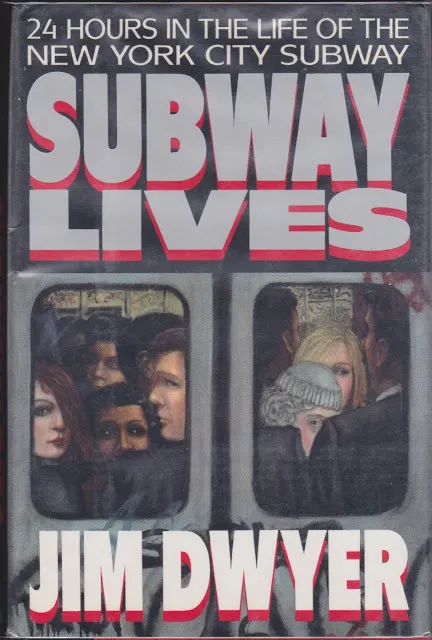
First edition of Subway Lives published by Crown Publishers in 1991
Journalist Jim Dwyer's Subway Lives is an amazing series of non-fiction vignettes that revolve around the New York City subway system over a 24 hour span. Dwyer's account follows higher-ups in the Transit Authority, especially David Gunn, who is famous (and infamous) for ending the graffiti pandemic on the subway, a pregnant woman who gives birth on the subway, petty thieves, a mentally challenged teen, traffic control rooms, subway police, a conductor with a strange penchant for singing, and a few of New York's most famous graffiti writers at the time, Reas, JA, Soni, and Slick. Interspersed with a bevy of historical information about the subway system and statistical figures, Dwyer's book is a treasure trove of late 1980's/early 1990's New York City. While this book will obviously appeal more to New York natives or people who have lived here, it is still an interesting social study from a particularly transformative time in the history of the city and it's world renowned subway system. Dwyer himself is a New York City native and covered the subway beat for New York Newsday in the late 1980's before reporting for the Daily News and eventually the New York Times. With excellent book design by June Bennett-Tantillo, Subway Lives remains an artifact of a bygone time in New York City.

Wednesday, November 7, 2012

Brave New World by Aldous Huxley
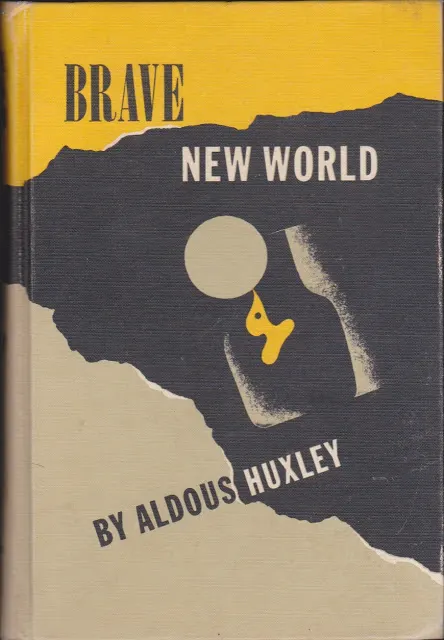
Library edition of Brave New World from some time in the 1960's
First published in the UK in 1932, Aldous Huxley's Brave New World has since become a modern classic of dystopian literature. While it is a great book, there is hardly anything rare about it—with the exception of this obscure made-for-library edition which I haven't encountered again since acquiring the copy pictured. There is no exact publication date anywhere on the inside of the book, but I was able to track it to sometime in the early 1960's through Harper & Row's publication history. I don't know if a definitive publication date exists anywhere though, at least not according to my research. Aside from having wonderful and simple jacket design wrapping around from cover to cover, this edition is remarkable for having the artwork printed directly onto the hardcover. I'm guessing the logic behind this decision was that the publisher assumed these copies would be handled a lot more and wanted to prevent the dust jacket from eventually deteriorating. If you happen on a copy like this one definitely jump on it—especially if you've never read about Mustapha Mond, Soma, and the Savages before.

Simple back cover stating the Harper Crest library edition

Monday, October 22, 2012

The Magic Barrel by Bernard Malamud
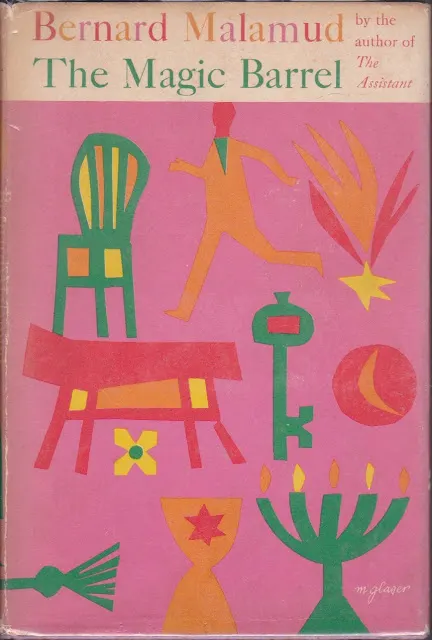

Later printing of The Magic Barrel published by FSG in 1967
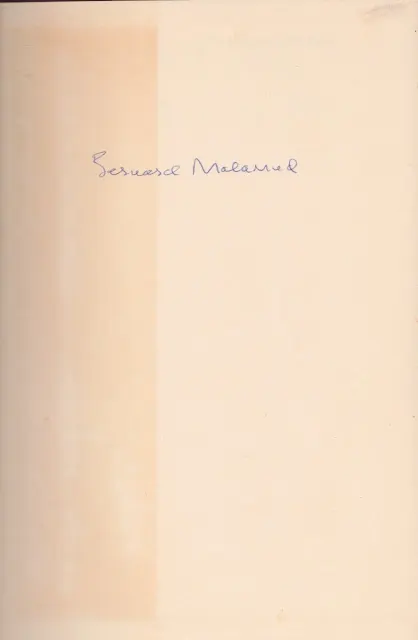
Bernard Malamud's collection of 13 short stories pictured above won the National Book Award in 1959, his first of two, and solidified his presence as a major emerging American writer. Writing largely about Judaism and its people, The Magic Barrel collects some of Malamud's finest short stories from the beginning of his writing career, some published as early as 1950. Malamud came to be considered a master of the short story, publicly praised by many of his colleagues, and now has a short story award named after him given out by the PEN foundation. The eponymous story from this collection is about a young rabbi named Leo Finkle about to begin his congregation, who is in search of a bride in order to get a bigger flock. Finkle sees a marriage coordinator, who gives him pictures of potential brides, except the one he likes most is the coordinator's daughter and comedy ensues. This later edition, which is virtually identical to the first edition, has amazing jacket design by Milton Glaser, the famous designer who made the I ♥ NY logo among many other things. Pictured below is Malamud's simple, script signature on the front endpaper.

Tuesday, October 16, 2012

Poema a Fumetti/Poem Strip by Dino Buzzati

First Italian edition of Poema a Fumetti from 1969
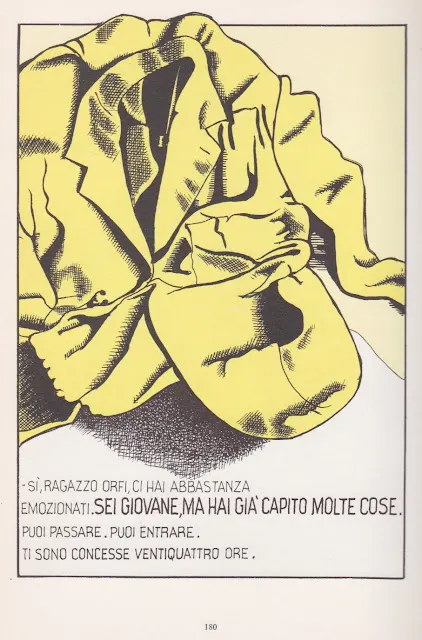
Poema a Fumetti, or Poem Strip in English, is Italian novelist Dino Buzzati's graphic masterpiece; it tells the story of singer Orfi and his quest to reclaim his girlfriend Eura after she disappears through a small door into a mansion on their street, the via Saterna, that isn't located on any maps. Loosely based on the myth of Orpheus, Buzzati's graphic novel is in many ways the first of its kind—it is literally an illustrated novel roughly the physical size of an average hardcover that traces Orfi's decent down into the mansion. Poema a Fumetti was entirely written and drawn by Buzzati himself, and features beautiful, surreal cityscapes and even more beautiful nude women (a healthy sampling of both are pictured below), clearly drawing on influences from Fellini and de Chirico. There are a bevy of weird characters and scenes, particularly a talking jacket among them, as Orfi navigates the netherworld looking for Eura. Buzzati's work remains standing as a perfect sampling from the height of 1960's Italian avant-garde art and literature. Originally published by Arnoldo Mondadori Editore, Poema a Fumetti was most recently republished in English by NYRB Classics in 2009 and is well worth the quick, bizarre read.


Tuesday, October 9, 2012

Tree of Smoke by Denis Johnson

First edition of Tree of Smoke published by FSG in 2007
I'll start by saying that Tree of Smoke is one of my favorite books; it tells the sprawling tales of Skip Sands and the Houston brothers, among others, during and partially after the Vietnam war. Focused largely around the CIA's involvement in the war during its formative years, Tree of Smoke is told from many intertwining points of view, including Vietnamese intelligence officers, German assassins, and world-weary Colonels. Johnson's novel even has a complete, masterful recreation of the Tet offensive that is insanely gripping. Readers of his other work will remember the Houston brothers from his first novel Angels, which takes place later in time during the 1980's. Johnson's novel isn't particularly weird or rare, having won the National Book Award for 2007 and being a bestseller, but it is awesome, as is my copy he signed pictured below. This first edition hardcover also features great jacket art and design done by Susan Mitchell, which is increasingly rare these days. I strongly recommend picking up a copy especially seeing as they're not in short supply.
 
An inscription made out to me on the title page—note that he initially misspelled my name so there's an e with a dot over it

Tuesday, October 2, 2012

62: A Model Kit by Julio Cortazar

First US edition of 62: A Model Kit published by Pantheon/Random House in 1972
Julio Cortazar's fifth novel is an offshoot of chapter 62 from his mammoth book, Hopscotch, which is only a few pages long and recounts the outline for a potential novel from a few scraps of paper that the character Morelli is planning to write. The primary basis for the novel is that it takes place in a world wherein human behavior is indefinable by psychology. This novel, 62: A Model Kit is at the same time a continuation of that brief chapter about Morelli as much as it is a follow-through of the novel upon which the notes were based. Cortazar's slimmer, semi-sequel to Hopscotch isn't quite as good as its progenitor, but it is still a whimsical, interesting read about a pre-ordained world only Cortazar could have created where anything can take place. It can also be read independently of Hopscotch, which may appeal more to first-time Cortazar readers not brave enough to commit to a 500+ page read. This first edition features great companion cover art to Hopscotch by Kenneth Miyamoto—George Salter unfortunately died five years earlier, otherwise I'm pretty sure it's safe to say he would have done the jacket design for this book as well.

Monday, September 17, 2012

Perfect Rigor by Masha Gessen

First edition of Perfect Rigor published by Houghton Mifflin Harcourt in 2009
Perfect Rigor is an interesting biography in that it recounts the life of famed, reclusive mathematician Grigori Perelman, but was written completely without any interviews or information of any kind from Perelman (who is still living). Perelman became famous in the last decade for his solving of the Poincare Conjecture, one of the world's more famous unsolved problems and one of several Clay Millenium Problems whose solution earns the winner a million dollars. Perelman oddly posted his solutions on the internet in three relatively brief papers that took years for others to digest, and was ultimately correct. He is particularly famous for rejecting a Fields Medal and the million dollar prize, among other things, and retreated back to Russia to live in a depressing flat block with his mother. Perelman has also since ceased trimming his beard or fingernails. Gessen's biography recounts Perelman's upbringing as a bright math prodigy and Jew behind the Iron Curtain, through the collapse of the Soviet Union and his eventual migration to America to begin teaching. Told mostly through interviews with contemporaries and people who've known and worked closely with Perelman, Gessen's book paints a seemingly accurate portrait of a genius who has no interest in others knowing about his life, and is enthralling to read. With book design by Brian Moore, this edition is surprisingly inoffensive for a more recent hardcover publication and is currently still in print.

Tuesday, September 4, 2012

Hebdomeros by Giorgio de Chirico
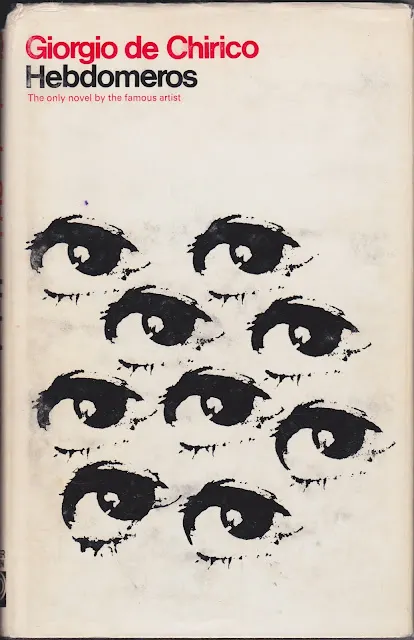
First English edition of Hebdomeros published in the UK by Peter Owen in 1964
Giorgio de Chirico was primarily known for his large body of surrealist art in the first half of the 20th century; Hebdomeros was de Chirico's only foray into fiction. This slim novel, also titled Hebdomeros the Metaphysician, was first published in French in 1929 and recounts the protagonist Hebdomeros' travels throughout a bevy of surreal landscapes as well as his journey inward. Hebdomeros isn't easy to read in that it doesn't have a narrative so to speak, but it is like reading a really good succession of dreams. Written during a "block" in his painting career, de Chirico's novel ironically deals largely with Hebdomeros' humanity and the people around him, which comes in stark contrast to his paintings which are almost always barren landscapes devoid of people. This first English edition comes peppered with illustrations by de Chirico and features nice jacket design by Keith Cunningham.

Wednesday, August 22, 2012

The Big Clock by Kenneth Fearing
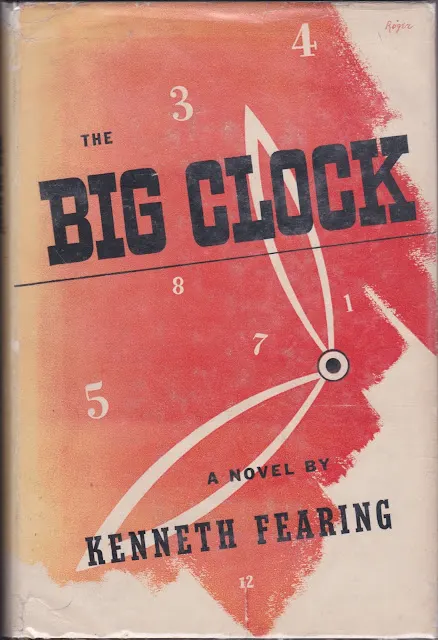
First edition of The Big Clock published by Harcourt Brace in 1946
This thriller by Kenneth Fearing is my favorite of his books; The Big Clock tells the enthralling story of George Stroud, family man and news executive, who is the last person to see his mistress Pauline Delos alive. The problem is that he knows his boss, powerful news magnate Earl Janoth, is the murderer. Janoth knows someone was in the shadows the night she was killed but he can't figure out who it was, and uses the vast media resources of Janoth Enterprises to track down this supposed murderer, most specifically his publication "Crimeways," which George Stroud heads up. Tasked with having to track himself down, Stroud must race against time to prove his own innocence and Janoth's guilt. The Big Clock is stylistically unique, especially for a crime novel from 1946, in that most of the chapters are told from a different character's point of view while juggling the plot. It is also poetically eerie in certain ways like how each member of George Stroud's family has a variation of the name George (i.e. Georgette and Georgia), and all of Janoth's publications have the same kind of title ("Futureways," "Newsways," etc.). Fearing's novel feels like it exists within a noir-ish microcosm of old New York and is tremendously fun to read. This first edition features great cover art attributed only to someone who signed "Roger" on the top right corner of the front cover.

Thursday, August 16, 2012

The Catcher in the Rye by J.D. Salinger
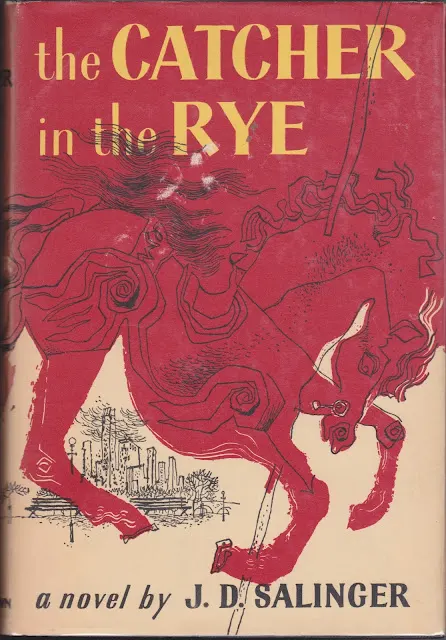
Book of the Month Club edition published by Little, Brown in 1951
This is a book that doesn't really need an introduction or synopsis; it also isn't predominantly weird or rare (except for the edition), and falls mostly into the category of cool. This copy of The Catcher in the Rye was published later in 1951, the same year as its initial publication, although was part of the third or fourth printing for the Little, Brown Book of the Month Club (BOMC). The main aesthetic difference between later printings and the first edition is that the first run had Salinger's photo on the back cover and he demanded that it be taken off for future editions. A secondary printing by Grosset & Dunlap around the same time had advertisements on the back cover, which he also demanded be taken off, and so all subsequent printings just had blank white on the back (which I would have scanned except it is literally just an empty white space). The cover of Salinger's only full-length novel features amazing, and now iconic, jacket design by Michael Mitchell (sometimes credited as E. Michael Mitchell) depicting a carousel horse in Central Park and part of the city. After its publication, Salinger became friends with Mitchell and corresponded for the better part of four decades. On the back flap Salinger is quoted as saying, "I've been writing since I was fifteen or so. My short stories have appeared in a number of magazines over the last ten years, mostly—and most happily—in The New Yorker. I worked on The Catcher in the Rye, on and off, for ten years." I value this copy immensely, despite the small physical imperfections on the cover, and will have to do because first printings go for many thousands of dollars.

Sunday, August 12, 2012

Warlock by Oakley Hall

First edition of Warlock published by Viking Press in 1958
Oakley Hall's most famous novel is about the denizens of this eponymous town and their struggle to maintain order against criminals and cowboys in the Wild West. Amid a sprawling cast of characters in Warlock, Clay Blaisedell becomes the hero gunslinger meant to restore order to the lawless town and its people held captive under the oppressive rule of free-wielding outlaws. Hall's novel is lengthy and can be difficult at times, especially given its high degree of attention with regards to language—also one if its greatest feats. Thomas Pynchon and Richard Fariña initially bonded at Cornell over their shared passion for Hall's masterpiece, and according to Pynchon, spoke to each other "in Warlock dialogue, a kind of thoughtful, stylized, Victorian-Wild West diction." In reading their work it's clear to see the influence Hall's novel had on both of them. This first edition features great Western pistol cover artwork by Charles Egri and Evelyn Curro.

Wednesday, August 1, 2012

The Iron Clew by Alice Tilton
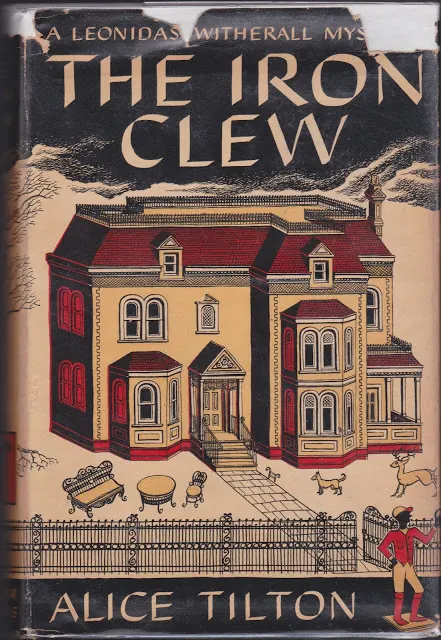
Hardcover first edition of The Iron Clew from 1947
Pictured above is the eighth and final installment of Phoebe Atwood Taylor's Leonidas Witherall mystery series (writing under the pen name Alice Tilton). Published by Farrar, Straus and Company (before Giroux was around), The Iron Clew continues the story of Leonidas Witherall, an anonymous mystery writer himself whose novels recount the adventures of Lieutenant Hazeltine, who is interrupted from his pastime when he must attend a dinner at fellow banker Fenwick Balderston's home. Upon arriving Balderston has been murdered with a bust of Shakespeare, and Leonidas and his band of helpers must set out to solve his murder. Tilton's Witherall novels are all engaging murder mysteries but of a lighter, more whimsical sort, and she comes up with some of the best names in fiction. While the cover of my copy is unfortunately slightly torn at the top, it still shows one the best book cover illustrations I've come across by Ronald Clyne. These mysteries are obviously dated, having been written over half a century ago, but they still exist as a unique, sardonic take on a genre that is almost always overly serious.

Wednesday, July 25, 2012

The Queen's Gambit by Walter Tevis
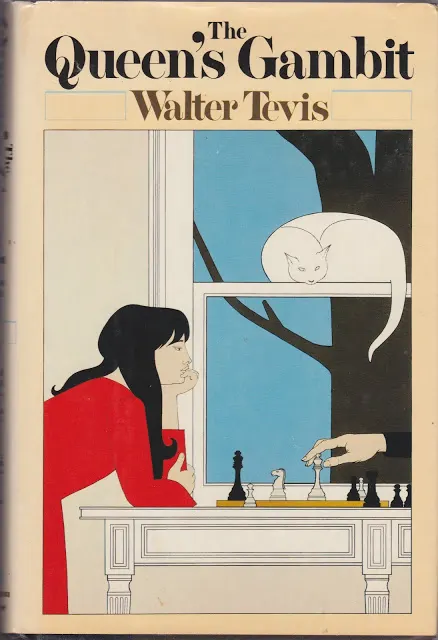
First edition of The Queen's Gambit published by Random House in 1983
Walter Tevis' fifth and second to last novel is about the ascent of female chess prodigy Elizabeth Harmon. Orphaned when her mother dies at age 8, Beth spends the next five years in the Methuen home for girls and learns how to play chess covertly with one of the janitors while combating an addiction to tranquilizers. Beth is eventually adopted and steals money to play in a tournament, where she finally becomes recognized as the talent that she is. The Queen's Gambit follows Beth from her humble beginnings to challenging the world champion at 18, and, despite being extremely chess-heavy in detail, is incredibly gripping and fun to read. I have yet to read or even hear of another book that deals with the plight of the female chess player in an almost always male-dominated field. The Queen's Gambit is easily in contention for my favorite of Tevis' novels, and this first edition features great jacket art by Will Barnet.

Sunday, July 15, 2012

The Corridors of Time by Poul Anderson
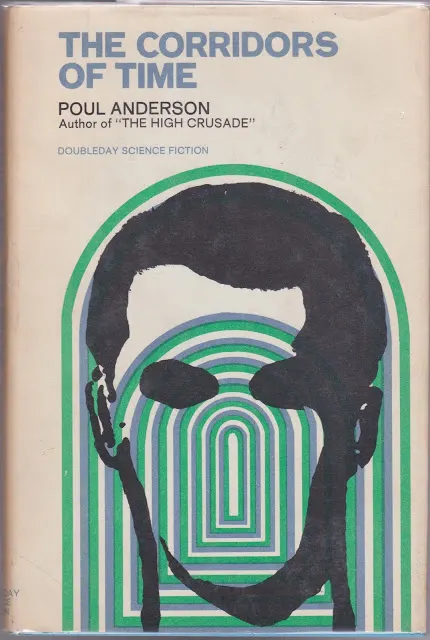
Book club edition of The Corridors of Time from 1965
Published by Doubleday Science Fiction, Poul Anderson's The Corridors of Time is about former death-row inmate Malcolm Lockridge's travels through time, guided by Storm Dalloway, who has just broken him out of prison. In one corridor of time Dalloway was a leader of the Wardens, a group warring against the Rangers, who enlist the help of Malcolm Lockridge before he can settle down in a time period of his choosing. Spanning many centuries and different eras, Anderson's novel can be a little hokey at times but still enjoyable enough to read. Anderson belonged to a sect of science fiction writers who were beyond prolific in their lifetime; this book was probably written among four or five other novels in 1964/1965 and sort of shows. I think this book is most important, though, as a relic from a period of publishing and literary history that no longer exists—incredibly imaginative, pulpy science fiction novels with amazing book design by masters of the genre. The Corridors of Time is a great example of all these things, and features beautiful jacket design by Tom Chibbaro.

Saturday, July 7, 2012

Purgatory Street by Roman McDougald
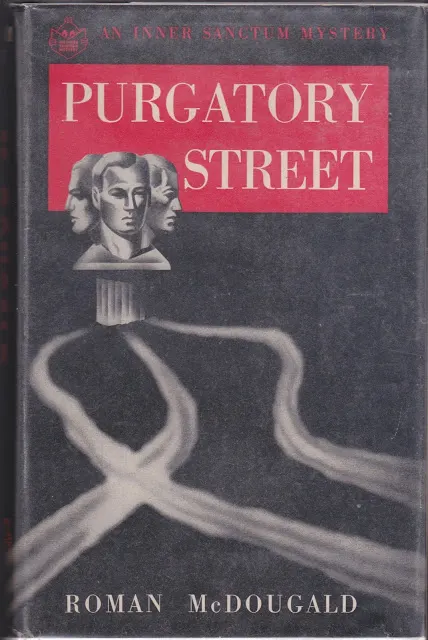
First edition from 1946, published as an Inner Sanctum Mystery under Simon and Schuster
This beautiful pulp-mystery by Roman McDougald (his third book) tells the story of Mona and her husband Chan, who has just returned home from World War II. Except that Chan is not the same man he was before the war—at all. As Mona falls deeply in love with this impostor, she must come to face the grim reality that he has murdered her husband to claim his inheritance and will invariably have to kill again. This simple story from over half a century ago is fun to read despite being incredibly dated. Published by Simon and Schuster as part of their Inner Sanctum Mystery series, Purgatory Street also features amazing jacket design and illustration by H. Lawrence Hoffman.

Rear cover featuring an advertisement for The Widow-Makers by Michael Blankfort

Saturday, June 23, 2012

The Kremlin Letter by Noel Behn
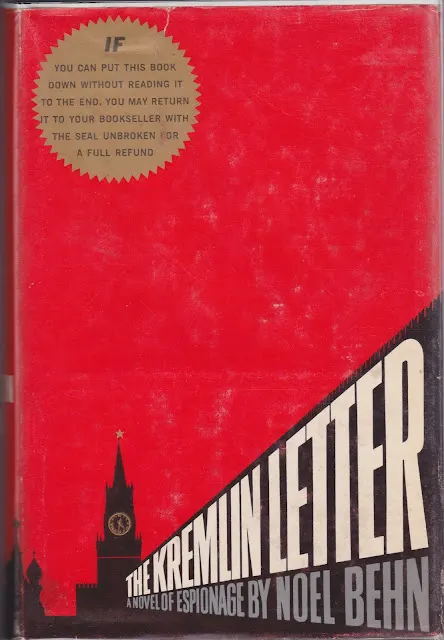
Fourth edition hardcover from 1966 printed by Simon and Schuster
Noel Behn's first novel and spy thriller was made most famous by John Huston's film adaptation from 1970, several years after The Kremlin Letter was first published. The novel and film both tell the story of several American intelligence officers clandestinely fighting against the Russians at the height of the Cold War to capture this eponymous letter. Filled with intrigue, Behn's book is equally as engaging as the movie and definitely deserves a read. Along with beautiful, simple jacket design by Paul Bacon, this edition is particularly amazing and unique because of the marketing strategy employed by Simon and Schuster. As stated on the front cover and on the inside, "IF you can put this book down without reading it to the end, you may return it to your bookseller with the seal unbroken for a full refund." Below are pictures of the seal (which clearly remains intact—I read a different copy), that begins on page 67 and binds the remaining pages of the book. Simon and Schuster were apparently convinced that readers would love the book so much that they offered this free return option if the reader didn't like the first few chapters. I have never seen another book or publisher employ this technique, and I'm guessing for that reason it didn't work very well and wasn't worth the effort. Still, I think it's amazing that they even tried.

The seal pictured from the front

Side view of the seal showing it "unbroken"