Showing posts with label French. Show all posts

Friday, December 14, 2012

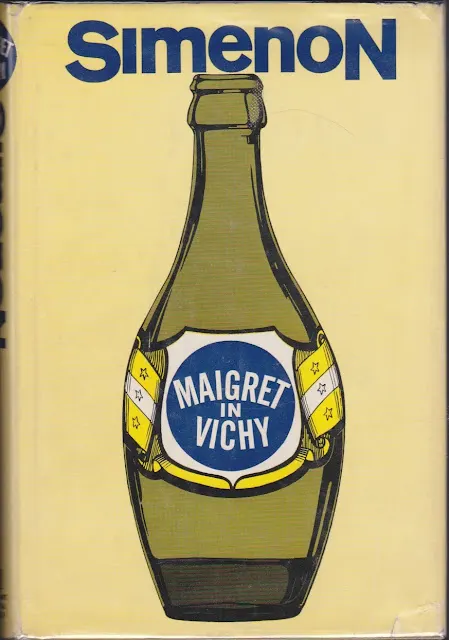
Maigret in Vichy by Simenon

First US edition of Maigret in Vichy published by Harcourt Brace in 1969
One of Simenon's later works featuring the renowned Inspector Maigret, Maigret in Vichy is a slightly different Maigret tale in that it doesn't take place in Paris and Maigret is not in the driver's seat for this mystery. While relaxing on vacation with his famously passive wife in the town of Vichy, Maigret can't help but let his detective mind get to work analyzing the town's inhabitants and others on vacation. He is quickly drawn to a lone woman he keeps seeing, and when murder invariably ensues the local police look to Maigret for his expertise, once again putting his poor wife on hold. Maigret in Vichy is a quick engaging thriller like nearly all of the Inspector Maigret novels, but with a pleasant twist and change of scenery. This first American edition also has one of my favorite covers ever, featuring stellar, simplistic jacket design by Ken Braren.

Friday, September 21, 2012

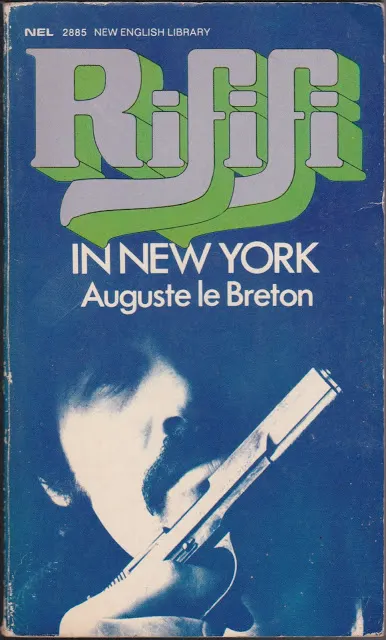
Rififi in New York by Auguste le Breton

Paperback edition from 1970 published by the New English Library
First published in France in 1967, Rififi in New York is part of Auguste le Breton's series of Rififi crime novels featuring an assortment of criminals and cops that take place in various cities around the globe. Le Breton himself began his career as a small-time crook, calling himself "a man of the underworld," and later became a hero in the Resistance during the Nazi occupation of France. After the war le Breton turned his focus to writing, and became a prolific writer of novels that typically revolve around criminals and their schemes or heists. Le Breton was a big proponent of slang in his novels, and coined the word "Rififi," which he legally owned, and is slang for a sort of conflict or melee. Rififi in New York is one of the better Rififi novels (next to the original Rififi) and features a crew of independent gangsters as they try and steal $20 million in jewels from the Diamond Exchange, all the while trying to stave off the mafia and the police. Le Breton came to New York to write this novel, and it features a greatly detailed landscape of 1960's New York City. With great cover art and typography by an unknown designer, as well as an odd Charles Bronson look-alike, le Breton's novels and Rififi in New York definitely deserve checking out.
Sunday, September 9, 2012

Impressions of Africa by Raymond Roussel

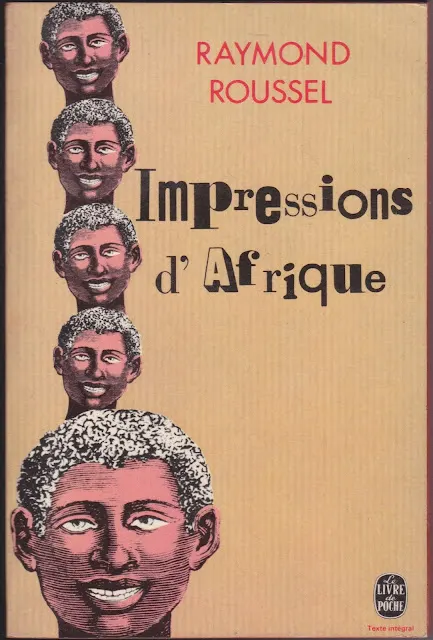
Early French paperback printing of Impressions of Africa
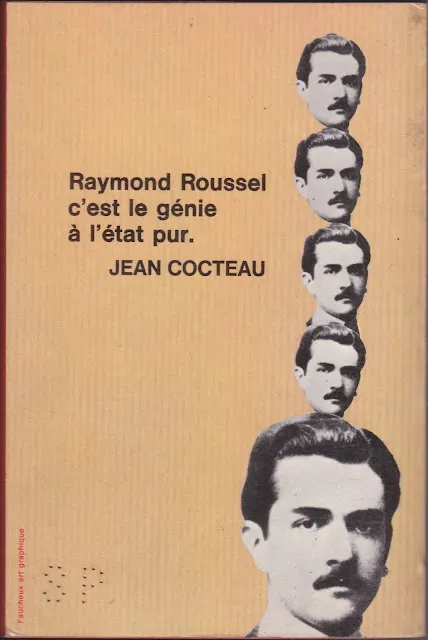
This French novel by Raymond Roussel was an inadvertent forefather to the surrealist movement; Impressions of Africa recounts the fantastical tale of shipwreck survivors to a fictitious land in Africa. Together, each distinct member must perform their unique, ridiculous talent before Emperor Talou, and great absurdities ensue. First published in 1910, Roussel's novel was also unique for its unusual narrative and sentence structure, which relies heavily on puns and other wordplay. Aside from being a little on the nonsensical side and somewhat dated, Impressions of Africa is not difficult to read and is definitely worth giving a shot. This French edition by Livre de Poche from 1963 is particularly notable for it's amazing covers done by renowned designer and illustrator Pierre Faucheux, who revolutionized book covers in France from the 1950's and 1960's on, treating them as works of art. These surrealist collages that don the front and back of this edition are perfect examples of his work. 

Back cover with Roussel's photo, note the Faucheux credit in the bottom left corner

Tuesday, September 4, 2012

Hebdomeros by Giorgio de Chirico

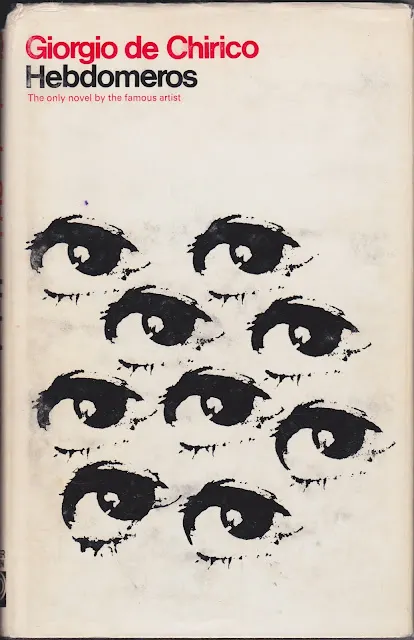
First English edition of Hebdomeros published in the UK by Peter Owen in 1964
Giorgio de Chirico was primarily known for his large body of surrealist art in the first half of the 20th century; Hebdomeros was de Chirico's only foray into fiction. This slim novel, also titled Hebdomeros the Metaphysician, was first published in French in 1929 and recounts the protagonist Hebdomeros' travels throughout a bevy of surreal landscapes as well as his journey inward. Hebdomeros isn't easy to read in that it doesn't have a narrative so to speak, but it is like reading a really good succession of dreams. Written during a "block" in his painting career, de Chirico's novel ironically deals largely with Hebdomeros' humanity and the people around him, which comes in stark contrast to his paintings which are almost always barren landscapes devoid of people. This first English edition comes peppered with illustrations by de Chirico and features nice jacket design by Keith Cunningham.

Tuesday, July 17, 2012

Army of Shadows by Joseph Kessel

Pocket Francais paperback edition printed in 2007
Known in English as Army of Shadows, the official title of Joseph Kessel's 1943 novel in French is L'armee des ombres. I have read other books by Joseph Kessel (Belle de Jour, The Lion, etc.), which have translated copies currently in print, but I have a feeling that they pale in comparison to Army of Shadows—unfortunately, I've been unable to track down a readable copy of the only English translation printed in 1944 by Cresset Press. The main reason why I'm even aware of this book, along with most other English speakers, is because of Jean-Pierre Melville's film adaptation of the same name from 1969. The movie is a pleasantly sprawling tale of the French Resistance and its members as they try to combat oppressive Nazi forces in their homeland. Told on the bleaker side and shot in beautiful blue and gray hues of color, Melville's film adaptation is by far one of his best movies and my favorite. All of these things lead me to believe that Kessel's novel must be equally as amazing, if not more so. Based largely on Kessel's own war-time resistance experiences, as far as I understand it, the movie remains pretty faithful to the text. A year ago I sent an inquiry to NYRB about printing a new English translation but no one ever got back to me. Maybe there are rights issues or other things connected with Kessel's estate that I'm unaware of, but I hope that someday someone releases another English edition of this book so I can finally read it.

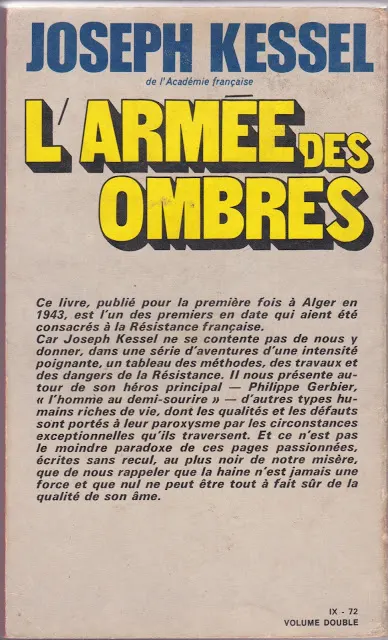
Back cover of an older Pocket Francais paperback from 1972 

Tuesday, May 15, 2012

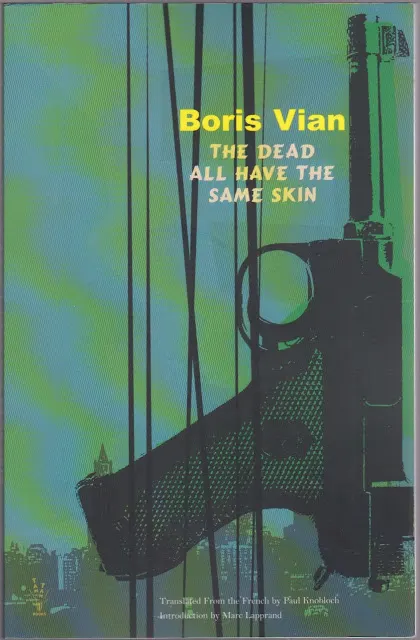
The Dead All Have The Same Skin by Boris Vian

Reprinted copy of The Dead All Have The Same Skin by Boris Vian
Boris Vian was a really odd guy in that a lot of his books were about part-black people and Americans, yet he was from Paris and never visited America. He was also completely white. They all take place in cities he never visited, and were about things he had never really experienced; but for this reason, his books are that much more interesting to read. Originally published in France in 1947, Vian claimed to have translated this book and several others from an American author called Vernon Sullivan—more than likely to distance himself from the lewdness, extreme sexuality, and racism that star in this book and most of his others. It soon came out that Vian himself had actually written them, both to popular acclaim and horror. They were successful in France and in the US for their bluntness, "forward-thinking," and ingenuity. The Dead All Have The Same Skin is about a quarter-black man who outwardly appears fully white to his family and co-workers, but whose world is overturned when his fully-black brother appears to extort him. Part noir and racial commentary, the story takes place in an awesomely imagined New York and Brooklyn in the late 1940's, features murder, fighting, drinking, police chases, profanity, and no fewer than 20 sexual exchanges in a novel that's just barely a hundred pages. This book—if you can believe it—is the most straightforward and least ridiculous of Vian's controversial work, although I highly recommend all of it. TamTam books reprinted this novel in 2007 and have since republished most of Vian's works.