Showing posts with label Literature. Show all posts

Monday, March 11, 2013

The Wanderers by Richard Price

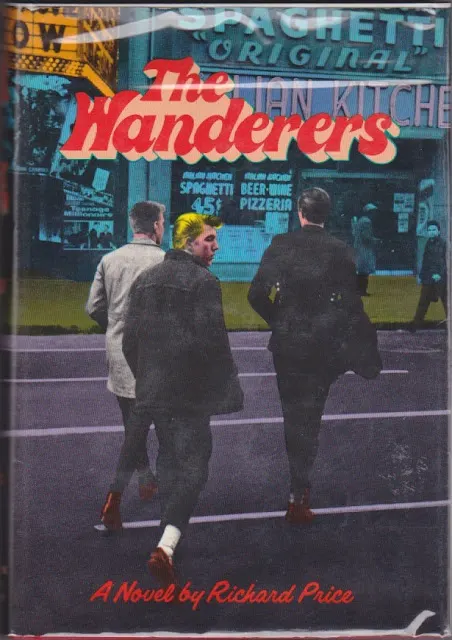
First edition of The Wanderers published by Houghton Mifflin in 1974
The Wanderers is Richard Price's first novel and one of his best; praised by everyone from William S. Burroughs to John Fowles particularly for it's realistic dialogue and accurate street vernacular, the story revolves around a group of teen gangs in the 1960's Bronx, New York City. One of the central characters is Richie Gennaro, leader of the Wanderers gang, and the story mainly follows his development, among other gang members, as he is forced to grow up and confront the real world in various ways. The Wanderers features an incredibly colorful cast of characters from around their neighborhood and rival gangs they must deal with like the Pips and the Baldies. This first edition has amazing cover art done by veteran jacket artists Batten & Kreloff, but The Wanderers is well worth the read no matter what edition you come across.

Monday, February 18, 2013

V. by Thomas Pynchon

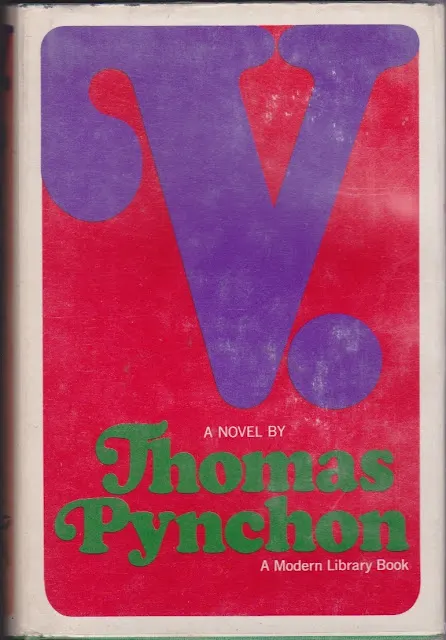
First Modern Library edition of V. by Thomas Pynchon from 1966
Thomas Pynchon's first novel, originally published in 1963, is a book that needs little introduction. Pynchon and his work, although widely known, all fall under the categories of cool, weird, and rare, and this Modern Library edition of his first novel is particularly scarce. V. is probably the most concentrated embodiment of what would later be known as Pynchon's hallmark weird, and technically daring style. It is less complex than Gravity's Rainbow, not to mention shorter, but in my view V. is just as good and definitely easier to get through. One plot line follows sailor Benny Profane and hangers-on from the Whole Sick Crew, and the other follows Herb Stencil and his family's history with a mysterious woman known as "V." The intricately laid plots eventually converge on each other as the novel progresses, forming a V-shape itself as Profane and Stencil cross paths and band together at the end to find V. Pynchon's first novel also features an amazingly diverse cast of characters, many of whom appear more prominently in later works like Pig Bodine and Kurt Mondaugen, and different segments set in various parts of history from all around the world. V. marked the beginning of a new kind of voice and style of writing that had never existed before, and is incredibly important for that reason alone, not to mention being the front bookend of Pynchon's oeuvre. This first Modern Library edition features great, simplistic 1960's cover art by S. Neil Fujita.

Friday, January 25, 2013

All About H. Hatterr by G.V. Desani

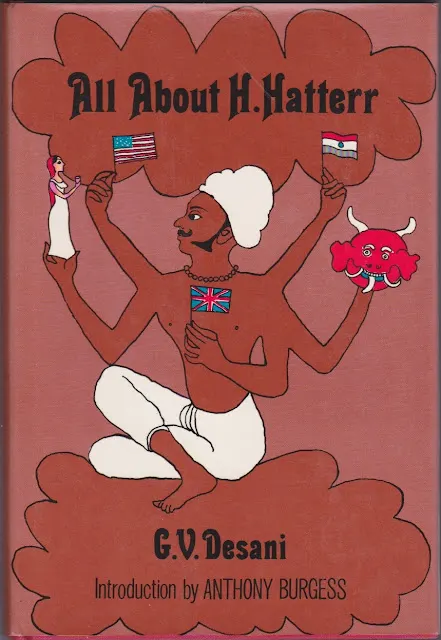
First further revised printing of All About H. Hatterr from 1970
First published in England in 1948, Pakistani author G.V. Desani's only novel remains a strange, whimsical masterpiece following the title character's journey toward spiritual mastery and enlightenment. Hatterr, an Anglo-Malay living in Calcutta, seeks out seven different Sages in seven cities of the Far East to obtain their wisdom in various areas of living. Each section begins with Hatterr recounting the Sage's "instruction," then the "presumption" about the instruction, and concludes with Hatterr's "life-encounter" about the lesson wherein some hilarity and absurdities ensue. All About H. Hatterr has been praised by literary luminaries like Anthony Burgess (who wrote the introduction for this edition), Saul Bellow, and T.S. Eliot, all of whom regard Desani's only novel as an amazing comic and linguistic feat—which it definitely is. Desani's novel is filled with bizarre and unique slang, hilarious dialogue, and excellent wordplay that makes fun of anything close to a spiritual quest. The Sages, various tricksters, and other travelers Hatterr encounters are particularly ridiculous, and are some of the book's funniest moments. With excellent jacket design by Catherine Smolich for this edition published by FSG, All About H. Hatterr is a great, entertaining book that has somehow fallen through a lot of cracks, but definitely deserves to be read.

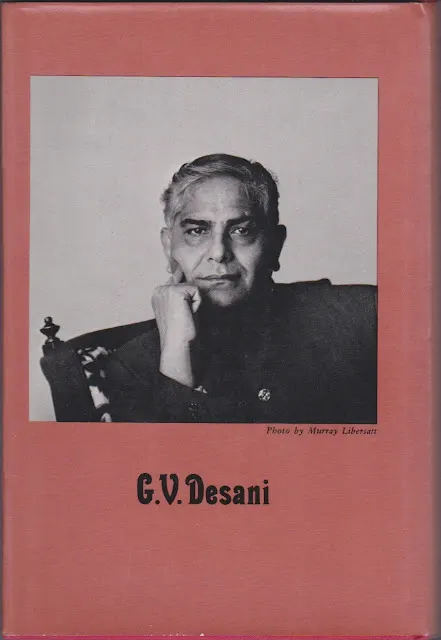
Rear cover with photograph of author G.V. Desani

Wednesday, January 2, 2013

The Cool World by Warren Miller

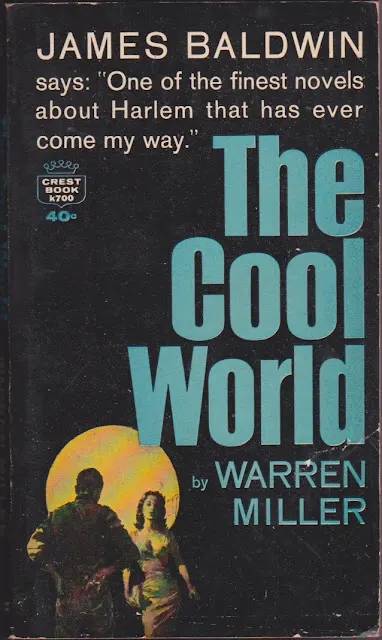
Second edition paperback copy of The Cool World from 1964 
First published in 1959, The Cool World is the most famous of Warren Miller's work (all of which is relatively unknown) about a youth gang called the "Crocadiles" in 1950's Harlem, New York City. Narrated in the first person by the protagonist and Crocadile member Duke, The Cool World recounts the story of Duke and his gang's adventures and travails as they deal with street life in the ghetto and a rival gang called the Wolves. Drug dealing, fights, prostitution, guns, and gambling are rampant throughout this engaging, slim novel that rarely has a dull moment. Written entirely in African-American street vernacular of the time, Miller—a caucasian academic—accomplished a great, and mostly unnoticed, linguistic and narrative feat with this novel. The Cool World has been out of print since the late 1960's, but paperback copies aren't too difficult to come by—the featured copy above was published by Crest Books, a subsidiary of Little, Brown. Slightly better known than Miller's novel is a film adaptation by Shirley Clarke of the same name, also from 1964, which happens to be playing at Film Forum in New York on January 13th and 14th. I strongly suggest seeing it if you live in the five boroughs, as well as locating a copy of this forgotten novel.

Wednesday, November 7, 2012

Brave New World by Aldous Huxley

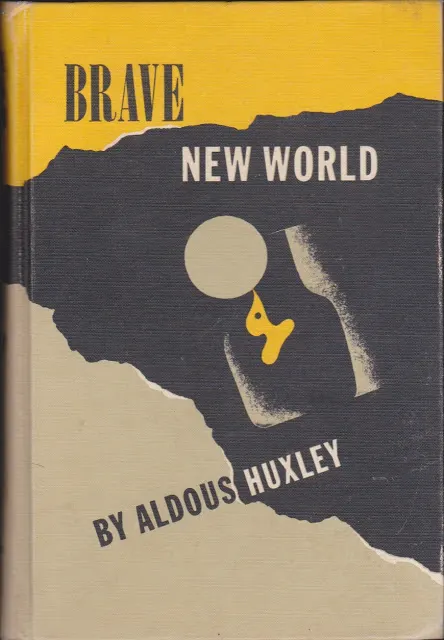
Library edition of Brave New World from some time in the 1960's
First published in the UK in 1932, Aldous Huxley's Brave New World has since become a modern classic of dystopian literature. While it is a great book, there is hardly anything rare about it—with the exception of this obscure made-for-library edition which I haven't encountered again since acquiring the copy pictured. There is no exact publication date anywhere on the inside of the book, but I was able to track it to sometime in the early 1960's through Harper & Row's publication history. I don't know if a definitive publication date exists anywhere though, at least not according to my research. Aside from having wonderful and simple jacket design wrapping around from cover to cover, this edition is remarkable for having the artwork printed directly onto the hardcover. I'm guessing the logic behind this decision was that the publisher assumed these copies would be handled a lot more and wanted to prevent the dust jacket from eventually deteriorating. If you happen on a copy like this one definitely jump on it—especially if you've never read about Mustapha Mond, Soma, and the Savages before.

Simple back cover stating the Harper Crest library edition

Monday, October 22, 2012

The Magic Barrel by Bernard Malamud


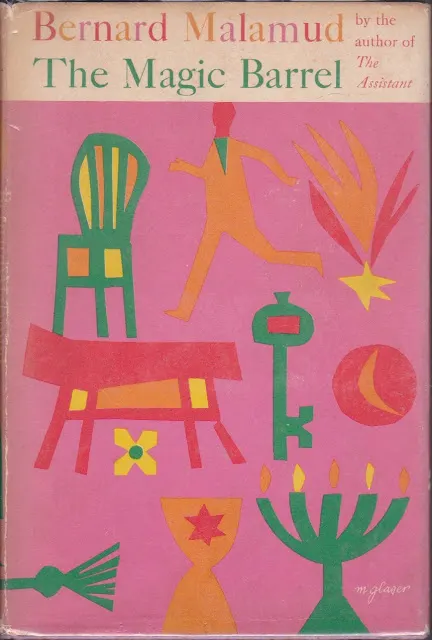
Later printing of The Magic Barrel published by FSG in 1967
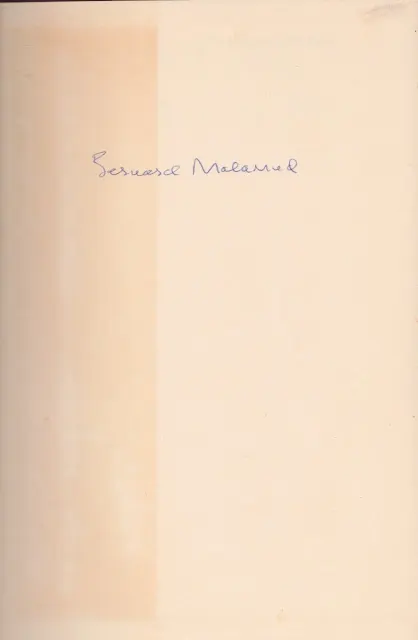
Bernard Malamud's collection of 13 short stories pictured above won the National Book Award in 1959, his first of two, and solidified his presence as a major emerging American writer. Writing largely about Judaism and its people, The Magic Barrel collects some of Malamud's finest short stories from the beginning of his writing career, some published as early as 1950. Malamud came to be considered a master of the short story, publicly praised by many of his colleagues, and now has a short story award named after him given out by the PEN foundation. The eponymous story from this collection is about a young rabbi named Leo Finkle about to begin his congregation, who is in search of a bride in order to get a bigger flock. Finkle sees a marriage coordinator, who gives him pictures of potential brides, except the one he likes most is the coordinator's daughter and comedy ensues. This later edition, which is virtually identical to the first edition, has amazing jacket design by Milton Glaser, the famous designer who made the I ♥ NY logo among many other things. Pictured below is Malamud's simple, script signature on the front endpaper.

Tuesday, October 9, 2012

Tree of Smoke by Denis Johnson

First edition of Tree of Smoke published by FSG in 2007
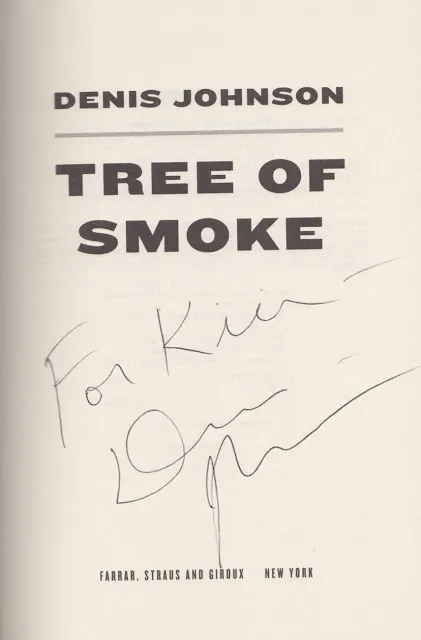
I'll start by saying that Tree of Smoke is one of my favorite books; it tells the sprawling tales of Skip Sands and the Houston brothers, among others, during and partially after the Vietnam war. Focused largely around the CIA's involvement in the war during its formative years, Tree of Smoke is told from many intertwining points of view, including Vietnamese intelligence officers, German assassins, and world-weary Colonels. Johnson's novel even has a complete, masterful recreation of the Tet offensive that is insanely gripping. Readers of his other work will remember the Houston brothers from his first novel Angels, which takes place later in time during the 1980's. Johnson's novel isn't particularly weird or rare, having won the National Book Award for 2007 and being a bestseller, but it is awesome, as is my copy he signed pictured below. This first edition hardcover also features great jacket art and design done by Susan Mitchell, which is increasingly rare these days. I strongly recommend picking up a copy especially seeing as they're not in short supply.
 
An inscription made out to me on the title page—note that he initially misspelled my name so there's an e with a dot over it

Tuesday, October 2, 2012

62: A Model Kit by Julio Cortazar

First US edition of 62: A Model Kit published by Pantheon/Random House in 1972
Julio Cortazar's fifth novel is an offshoot of chapter 62 from his mammoth book, Hopscotch, which is only a few pages long and recounts the outline for a potential novel from a few scraps of paper that the character Morelli is planning to write. The primary basis for the novel is that it takes place in a world wherein human behavior is indefinable by psychology. This novel, 62: A Model Kit is at the same time a continuation of that brief chapter about Morelli as much as it is a follow-through of the novel upon which the notes were based. Cortazar's slimmer, semi-sequel to Hopscotch isn't quite as good as its progenitor, but it is still a whimsical, interesting read about a pre-ordained world only Cortazar could have created where anything can take place. It can also be read independently of Hopscotch, which may appeal more to first-time Cortazar readers not brave enough to commit to a 500+ page read. This first edition features great companion cover art to Hopscotch by Kenneth Miyamoto—George Salter unfortunately died five years earlier, otherwise I'm pretty sure it's safe to say he would have done the jacket design for this book as well.

Thursday, August 16, 2012

The Catcher in the Rye by J.D. Salinger

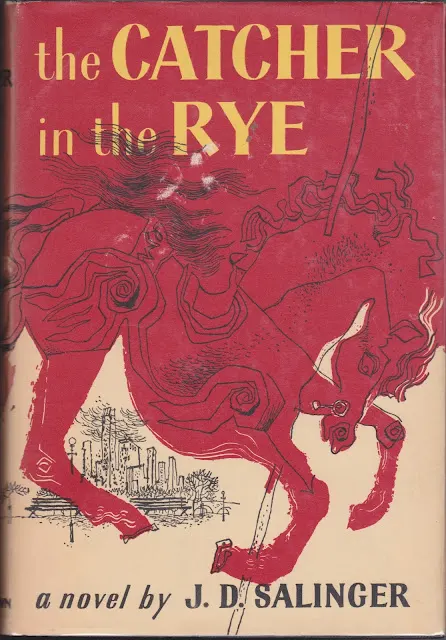
Book of the Month Club edition published by Little, Brown in 1951
This is a book that doesn't really need an introduction or synopsis; it also isn't predominantly weird or rare (except for the edition), and falls mostly into the category of cool. This copy of The Catcher in the Rye was published later in 1951, the same year as its initial publication, although was part of the third or fourth printing for the Little, Brown Book of the Month Club (BOMC). The main aesthetic difference between later printings and the first edition is that the first run had Salinger's photo on the back cover and he demanded that it be taken off for future editions. A secondary printing by Grosset & Dunlap around the same time had advertisements on the back cover, which he also demanded be taken off, and so all subsequent printings just had blank white on the back (which I would have scanned except it is literally just an empty white space). The cover of Salinger's only full-length novel features amazing, and now iconic, jacket design by Michael Mitchell (sometimes credited as E. Michael Mitchell) depicting a carousel horse in Central Park and part of the city. After its publication, Salinger became friends with Mitchell and corresponded for the better part of four decades. On the back flap Salinger is quoted as saying, "I've been writing since I was fifteen or so. My short stories have appeared in a number of magazines over the last ten years, mostly—and most happily—in The New Yorker. I worked on The Catcher in the Rye, on and off, for ten years." I value this copy immensely, despite the small physical imperfections on the cover, and will have to do because first printings go for many thousands of dollars.