Showing posts with label Crime. Show all posts

Friday, December 14, 2012

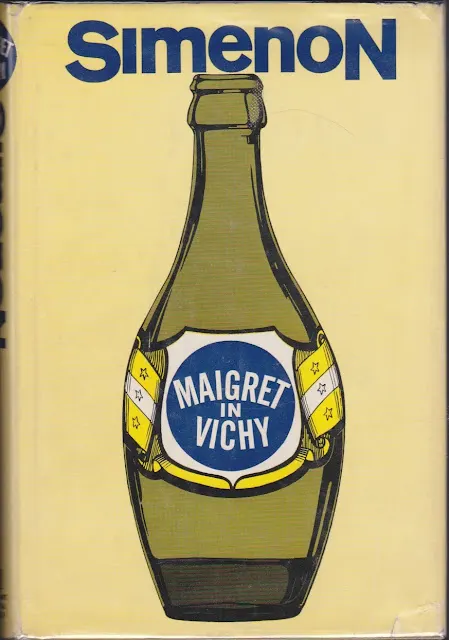
Maigret in Vichy by Simenon

First US edition of Maigret in Vichy published by Harcourt Brace in 1969
One of Simenon's later works featuring the renowned Inspector Maigret, Maigret in Vichy is a slightly different Maigret tale in that it doesn't take place in Paris and Maigret is not in the driver's seat for this mystery. While relaxing on vacation with his famously passive wife in the town of Vichy, Maigret can't help but let his detective mind get to work analyzing the town's inhabitants and others on vacation. He is quickly drawn to a lone woman he keeps seeing, and when murder invariably ensues the local police look to Maigret for his expertise, once again putting his poor wife on hold. Maigret in Vichy is a quick engaging thriller like nearly all of the Inspector Maigret novels, but with a pleasant twist and change of scenery. This first American edition also has one of my favorite covers ever, featuring stellar, simplistic jacket design by Ken Braren.

Friday, September 21, 2012

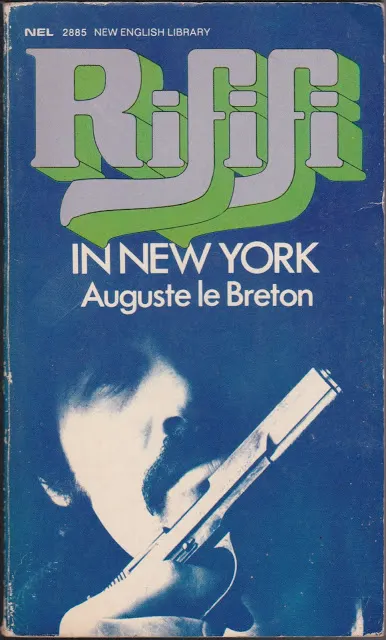
Rififi in New York by Auguste le Breton

Paperback edition from 1970 published by the New English Library
First published in France in 1967, Rififi in New York is part of Auguste le Breton's series of Rififi crime novels featuring an assortment of criminals and cops that take place in various cities around the globe. Le Breton himself began his career as a small-time crook, calling himself "a man of the underworld," and later became a hero in the Resistance during the Nazi occupation of France. After the war le Breton turned his focus to writing, and became a prolific writer of novels that typically revolve around criminals and their schemes or heists. Le Breton was a big proponent of slang in his novels, and coined the word "Rififi," which he legally owned, and is slang for a sort of conflict or melee. Rififi in New York is one of the better Rififi novels (next to the original Rififi) and features a crew of independent gangsters as they try and steal $20 million in jewels from the Diamond Exchange, all the while trying to stave off the mafia and the police. Le Breton came to New York to write this novel, and it features a greatly detailed landscape of 1960's New York City. With great cover art and typography by an unknown designer, as well as an odd Charles Bronson look-alike, le Breton's novels and Rififi in New York definitely deserve checking out.
Wednesday, August 22, 2012

The Big Clock by Kenneth Fearing

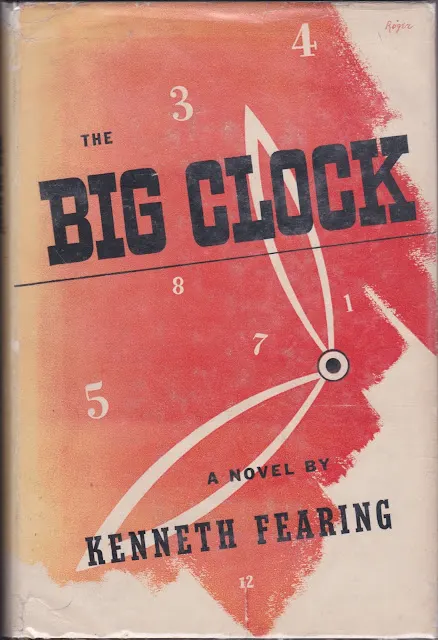
First edition of The Big Clock published by Harcourt Brace in 1946
This thriller by Kenneth Fearing is my favorite of his books; The Big Clock tells the enthralling story of George Stroud, family man and news executive, who is the last person to see his mistress Pauline Delos alive. The problem is that he knows his boss, powerful news magnate Earl Janoth, is the murderer. Janoth knows someone was in the shadows the night she was killed but he can't figure out who it was, and uses the vast media resources of Janoth Enterprises to track down this supposed murderer, most specifically his publication "Crimeways," which George Stroud heads up. Tasked with having to track himself down, Stroud must race against time to prove his own innocence and Janoth's guilt. The Big Clock is stylistically unique, especially for a crime novel from 1946, in that most of the chapters are told from a different character's point of view while juggling the plot. It is also poetically eerie in certain ways like how each member of George Stroud's family has a variation of the name George (i.e. Georgette and Georgia), and all of Janoth's publications have the same kind of title ("Futureways," "Newsways," etc.). Fearing's novel feels like it exists within a noir-ish microcosm of old New York and is tremendously fun to read. This first edition features great cover art attributed only to someone who signed "Roger" on the top right corner of the front cover.

Sunday, June 3, 2012

The Devil's Home On Leave by Derek Raymond

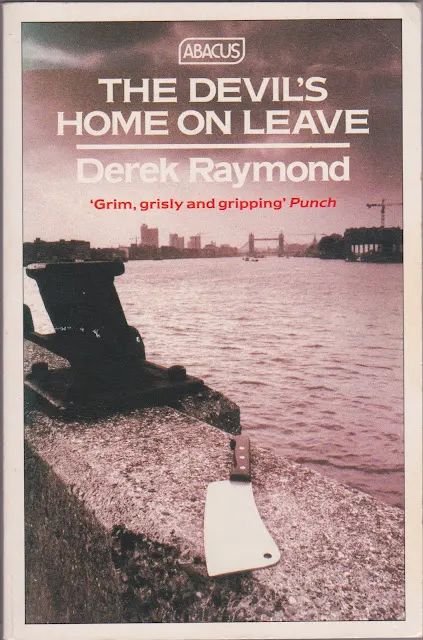
First British paperback edition from 1985 published by Abacus
This is the second book by Derek Raymond, the pen-name of English author Robert Cook, in his Factory Series about an unnamed Detective Sergeant working in the Unexplained Deaths department. The Devil's Home On Leave follows the Detective trying to solve the murder of a body chopped up, boiled, and casually dispersed on the street amongst five plastic shopping bags. Featuring a gritty cast of London underworld characters, known as "Villains," and the Detectives who pursue them, Raymond's novel is filled with intrigue and written mostly using amazingly authentic British slang. Raymond himself was a British gangster at one point, among many other things in his lifetime, before later becoming a novelist, and is considered to be the founder of British Noir with this series. Although this is the second book of five in the Factory Series, The Devil's Home On Leave is the best one in my opinion.

Tuesday, May 15, 2012

The Dead All Have The Same Skin by Boris Vian

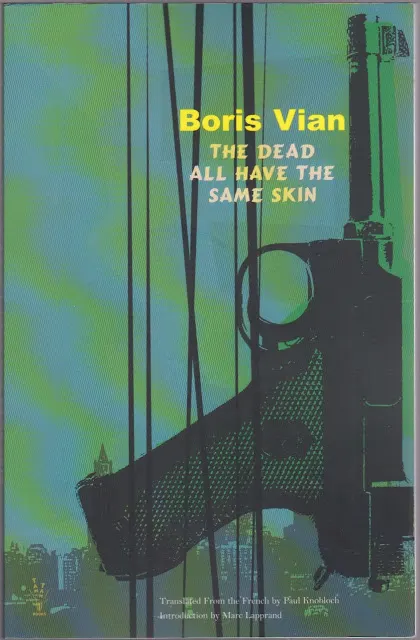
Reprinted copy of The Dead All Have The Same Skin by Boris Vian
Boris Vian was a really odd guy in that a lot of his books were about part-black people and Americans, yet he was from Paris and never visited America. He was also completely white. They all take place in cities he never visited, and were about things he had never really experienced; but for this reason, his books are that much more interesting to read. Originally published in France in 1947, Vian claimed to have translated this book and several others from an American author called Vernon Sullivan—more than likely to distance himself from the lewdness, extreme sexuality, and racism that star in this book and most of his others. It soon came out that Vian himself had actually written them, both to popular acclaim and horror. They were successful in France and in the US for their bluntness, "forward-thinking," and ingenuity. The Dead All Have The Same Skin is about a quarter-black man who outwardly appears fully white to his family and co-workers, but whose world is overturned when his fully-black brother appears to extort him. Part noir and racial commentary, the story takes place in an awesomely imagined New York and Brooklyn in the late 1940's, features murder, fighting, drinking, police chases, profanity, and no fewer than 20 sexual exchanges in a novel that's just barely a hundred pages. This book—if you can believe it—is the most straightforward and least ridiculous of Vian's controversial work, although I highly recommend all of it. TamTam books reprinted this novel in 2007 and have since republished most of Vian's works.

Monday, May 14, 2012

Homicide by David Simon

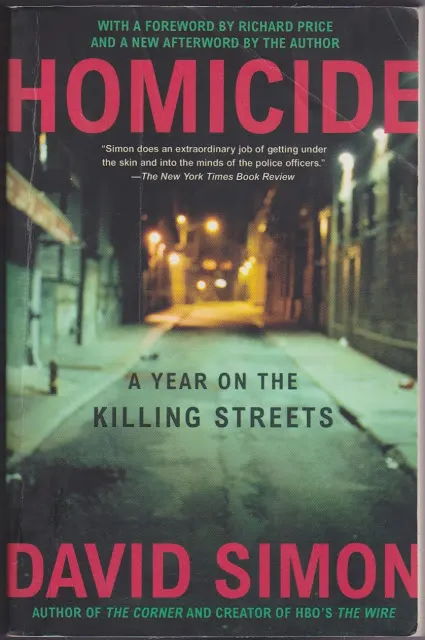
Reprinted paperback copy of Homicide by David Simon
This book falls more into the "Cool" category than any of the others heading this site, but it is definitely that. Journalist David Simon spent a year in the late 1980's with the Baltimore Police Department's homicide division at the height of a major crime surge—this book recounts his experiences shadowing homicide detectives as they worked their cases that year. It is an incredibly vivid and in-depth account of how police and detective work are done for murder cases, and can at times be slightly disturbing but definitely worth reading. This book of Simon's reportage later served as a partial basis for the HBO series The Wire, and anyone reading it after seeing the show should be able to spot the origins of certain things.